Danxia landform, Red sandstone landform in southeastern, southwestern and northwestern China
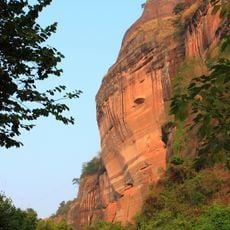
The Danxia landform is a set of red-bed landscapes of Cretaceous sandstone and conglomerate, faulted and uplifted, then eroded into steep cliffs, isolated towers and ridges. Its rocks resemble karst but are called pseudo-karst; shallow, isolated caves of various sizes and shapes are common. The type area is Mount Danxia near Shaoguan, Guangdong, where about 290 square kilometres of streams, forest and rock formations lie within Danxiashan Geopark.
In 1928 the mineral scientist Feng Jinglan, studying red beds near Mount Danxia in Renhua County, Guangdong, named the landform danxia after a poem by Cao Pi. Chinese geologists continued the research in the 1920s and 1930s. In August 2010 six areas, including Mount Danxia, Mount Langshan, Taining and Mount Longhu, entered the World Heritage List as China Danxia.
The name danxia comes from Cao Pi's 3rd-century poem "The Hibiscus Pool" and means "vermilion sunglow". Feng Jinglan coined it in 1928 after studying the red beds at Mount Danxia near Shaoguan, Guangdong. The term now labels red-bed cliffs across 26 Chinese provinces and regions, with 790 sites recorded by January 2008.
Access is provided through marked trails and viewing platforms connected by shuttle buses that offer a structured route through the landscape. Wear sturdy shoes and prepare for uneven ground, as the paths wind through hilly terrain with varying elevation changes.
The name danxia was coined in 1928 by mineralogist Feng Jinglan, who took it from Cao Pi's 3rd-century poem The Hibiscus Pool, where it means vermilion sunglow. The term was first applied at Mount Danxia near Shaoguan, Guangdong, the type locality studied by Chinese geologists in the 1920s and 1930s.
The community of curious travelers
AroundUs brings together thousands of curated places, local tips, and hidden gems, enriched daily by 92,786 contributors worldwide.