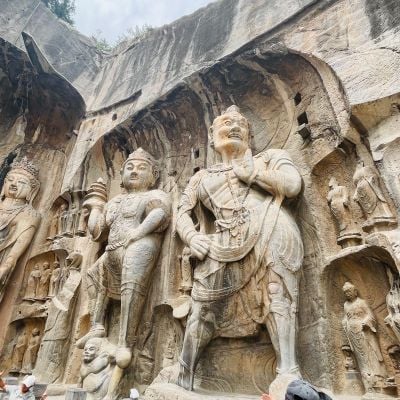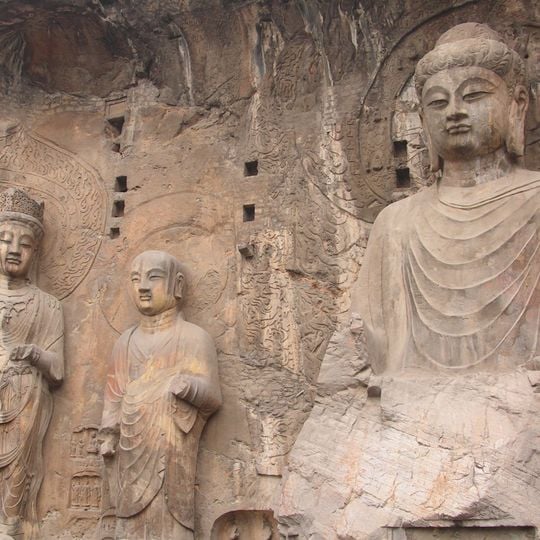
Longmen Grottoes, Buddhist rock sanctuary in Luoyang, Henan Province, China.
The Longmen Grottoes feature approximately 100,000 Buddhist statues carved into limestone cliffs along the Yi River, with sculptures ranging from tiny figurines to monumental figures reaching 17 meters in height.
Carving began in 493 when Emperor Xiaowen of Northern Wei moved his capital to Luoyang, and continued in four phases until 1127. The Fengxian Temple cave was completed in 675, and about 60% of the caves date from the peak years 626 to 755, when Emperor Gaozong and Empress Wu Zetian supported the work.
The name Longmen, "Dragon's Gate", comes from the two hills that pinch the Yi River like the gate towers that once marked the southern approach to Luoyang; the older name was Yique, "Gate of the Yi". The nearly 2,500 stelae and inscriptions earned the site the name "Forest of Ancient Stelae", and the Twenty Longmen Pieces are prized as models of Northern Wei calligraphy, while Chu Suiliang's stele for the Yique shrine is a standard of early Tang regular script.
The site operates daily from 8:00 AM to 5:30 PM at 13 Long Men Zhong Jie, Luo Long Qu, and visitors should prepare for walking along uneven pathways as wheelchair access is limited.
The colossal Vairocana Buddha statue in Fengxian Temple stands 17.14 meters tall and was possibly modeled after Empress Wu Zetian herself, reflecting the height of Tang Dynasty stone carving mastery.
The community of curious travelers
AroundUs brings together thousands of curated places, local tips, and hidden gems, enriched daily by 92,802 contributors worldwide.