North China Military Martyrs Cemetery, Memorial cemetery in Shijiazhuang, China.
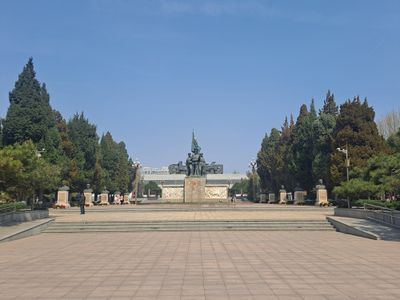
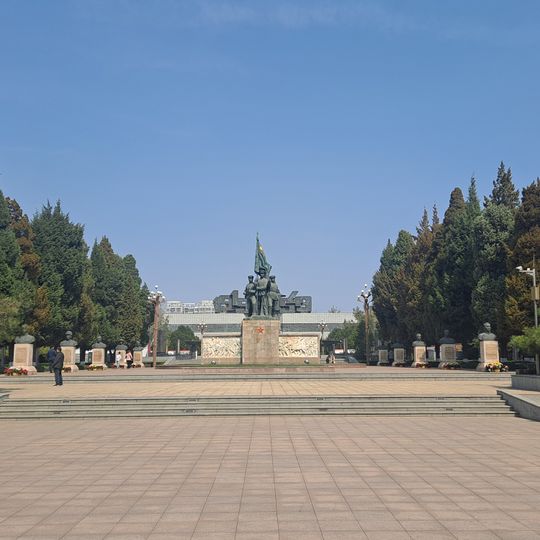
North China Military Martyrs Cemetery is a 210,000-square-metre memorial ground laid out symmetrically along a north–south axis. At its centre stands a 25-metre reinforced-concrete monument faced in light grey granite, with a red star and a bronze group of three soldiers holding a flag; four white-marble reliefs depict people's war, the liberation of Shijiazhuang, the Five Heroes of Langya Mountain, and Bethune and Kotnis treating the wounded. Low dark walls and rows of bust-topped pillars flank the stepped terrace.
The cemetery occupies the site of a Shinto shrine of the Japanese occupation forces, converted into a Victory Park after Japan's surrender in August 1945. In autumn 1948 Zhu De proposed building a cemetery for martyrs fallen in North China; construction began in March 1950 and the grounds opened on 1 August 1954. Chief engineer Wu Tianzhu designed it, with plans reviewed by Liang Sicheng, Zhang Kaiji and Song Bai. In 2008 it was also named Peace Park and admission became free.
The cemetery takes its name from the North China Military Region, whose fallen it commemorates. In the Memorial Hall, a white marble slab bears Mao Zedong's inscription "For the country's sacrifice, immortal forever" in gilded characters, and the north wall lists the names of 248 martyrs. A bronze wreath made by the Austrian expatriate Geist sits on the slab's marble base.
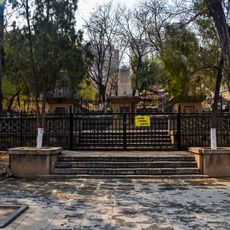
The grounds are laid out symmetrically along a north–south axis: from the gate, the 25-metre monument, then the Mingbei Hall, then the grave sections, with the Bethune and Kotnis tombs flanking the monument to west and east. The site is at 343 Zhongshan West Road, Qiaoxi District, and has been free of charge since 2008, when it also received the name Peace Park.
The cemetery holds the coffins of Norman Bethune, a Canadian physician who died in Tangxian County on 12 November 1939, and Dwarkanath Kotnis, an Indian doctor who died on 9 December 1942. Both were moved here from the Jin-Cha-Ji Martyrs Cemetery on 15 March 1953 and lie in facing plots on either side of a fountain.
The community of curious travelers
AroundUs brings together thousands of curated places, local tips, and hidden gems, enriched daily by 94,380 contributors worldwide.