City Wall of Xiangyang, Ancient fortification in Xiangyang, China
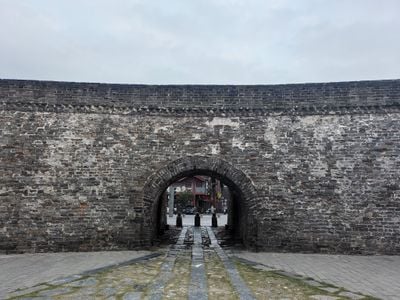
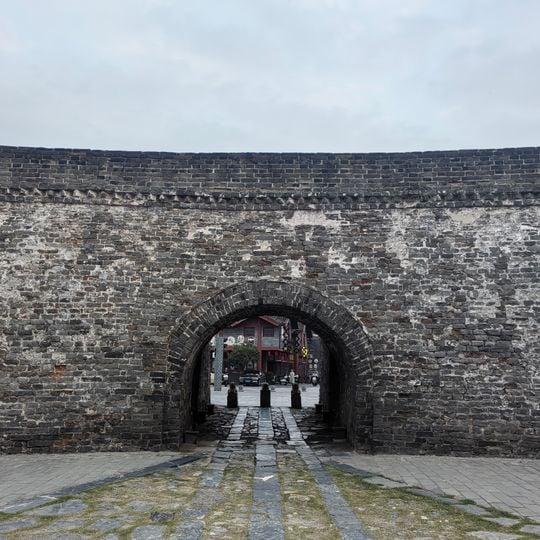
The City Wall of Xiangyang is built of dark grey and black bricks laid in horizontal courses with white mortar, its top running in a straight line beneath a slightly projecting brick coping. A single round-headed archway, its curved rim of the same dark brick, is centered in the wall and opens onto a paved area with buildings beyond. The wall stands on the south bank of the Han River, enclosing the old city.
The wall was originally built as a defensive structure during periods of regional conflict and played a crucial role during a lengthy siege by Mongol forces in the Southern Song era. Its present form largely dates from Ming Dynasty reconstruction and reinforcement.
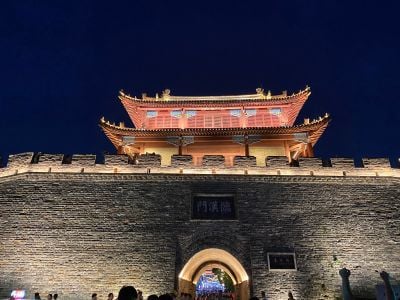
The six gates carry inscriptions by Wan Zhen Sun, magistrate during the Wanli era; in 1645 magistrate Dong Shangzhi added new plaques, of which only Linhan Gate (Small North Gate) survives. The wall is also the setting of the final part of Jin Yong's Condor Heroes trilogy, in which Xiangyang falls and Guo Jing and Huang Rong die defending it.
You can enter through multiple gates distributed around the perimeter, with a leisurely walk along the wall taking a few hours depending on your pace. Morning and late afternoon visits offer better conditions with cooler temperatures and fewer crowds.
The wall's outer face is brick, but its core is rammed earth, a Ming-era method of layering and compacting soil between brick skins. The moat reached 250 metres at its widest, part of a double defence system of gate courts and corner towers. Of the six gates, only Linhan Gate (the Small North Gate) survives.
The community of curious travelers
AroundUs brings together thousands of curated places, local tips, and hidden gems, enriched daily by 93,086 contributors worldwide.