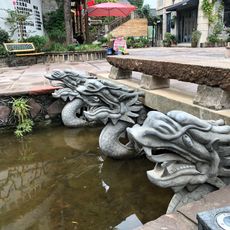
Screen Wall of Xiangyang King's Palace, Ancient palatial screen wall in Xiangyang, China.
The Screen Wall of Xiangyang King's Palace is a stone screen wall 25.12 m long, 1.6 m thick and up to 6.6 m high, built in 1438. Its body is inlaid with green vitriol, giving it a dark green colour. It is divided into three sections and carved with 99 dragons, including two dragons playing with a pearl in the central panel.
Zhu Zhanshan was enfeoffed as Prince of Xiang in 1424 and moved to Xiangyang in 1436 after complaining of Changsha's damp climate. In 1438 he built a princely residence that became the Xiangyang King's Palace; its screen wall survived when Zhang Xianzhong's troops burned the palace in 1641. The wall was listed as a Hubei provincial protected site in 1956 and as a Major Historical and Cultural Site Protected at the National Level in 2001.
The wall's 99 dragon reliefs include a central panel of two dragons playing with a pearl, flanked by water dragons facing inward amid wave patterns. Its name comes from the dark green glaze made from lüfan (green vitriol) inlaid across the body, not from weathering.
The site is easily accessible for visitors interested in exploring Chinese architectural heritage. Visit during daylight hours to fully appreciate the wall's surface details and how light affects its appearance.
The dark green tone is not a patina: the wall body is inlaid with lüfan (green vitriol, a copperas mineral), which gives the whole screen its colour. The wall carries 99 dragon reliefs in total, and the central section shows two dragons playing with a pearl among cloud and wave patterns.
The community of curious travelers
AroundUs brings together thousands of curated places, local tips, and hidden gems, enriched daily by 94,532 contributors worldwide.