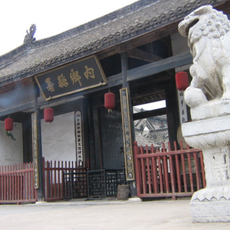
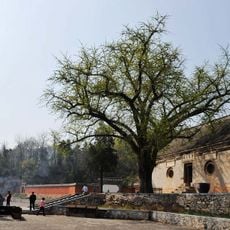
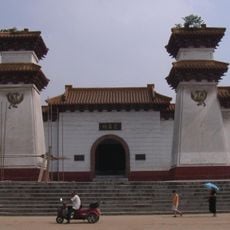
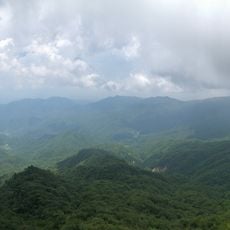
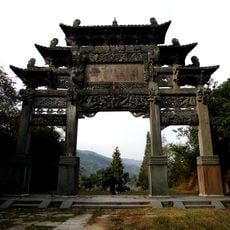
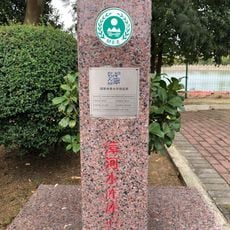
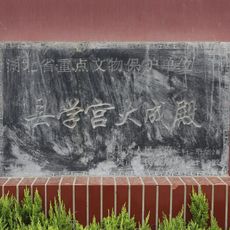
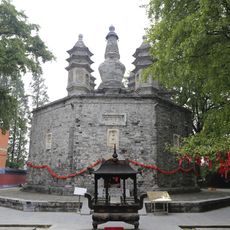
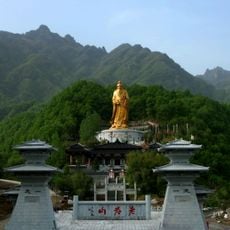
Nanyan Temple, Taoist temple in Wudang Mountains, China.
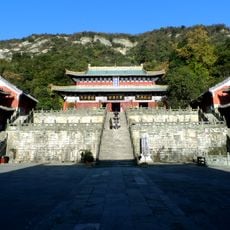
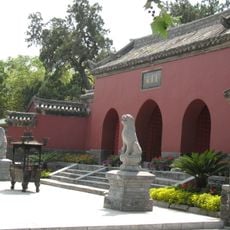
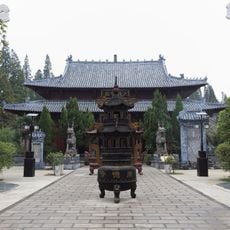
Nanyan Temple (Nanyan Gong) stands on the southern slope of the Wudang Mountains in Danjiangkou, Hubei. Its main hall, the Tianyi Zhenqing Palace, is a stone hall imitating timber construction, 6.8 m high with three bays in width and depth under a single-eaved hip-and-gable roof. North of it are the Nantian Gate, Yuhuang Hall and Longhu Hall; on the cliff side are the Liangyi Hall, Wansheng Tower and the Guqi Pavilion. The Liangyi Hall has a dragon-head stone carving projecting over the cliff, with an incense burner on top, known as the Dragon-Head Incense.
The sanctuary was built and expanded over many centuries to accommodate Taoist pilgrims drawn to the mountains. Local tradition connects the site with an emperor who underwent spiritual transformation here and was later venerated in Taoist teachings as a deity.
The name Nanyan means "Southern Cliff", referring to the rock face where the temple stands. The site is associated with Emperor Zhen Wu, who according to tradition found Taoism here and flew to heaven. Visitors can see the Longtou Xiang, a dragon-shaped stone projecting over the cliff with an incense burner on its head.
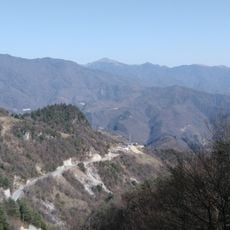
Reaching the site requires a mountain walk, so proper footwear is important for safe climbing and descent. Allow plenty of time for the ascent and bring water and sun protection, especially during hot or sunny weather.
The Dragon Head Incense Burner is a stone dragon protruding from the cliff outside the Liangyi Hall, with an incense burner set on its head. It is also called "Dragon Head Incense." The main hall, the Tianyi Zhenqing Palace, is a stone hall 6.8 meters high that imitates a wooden structure, with three bays in width and depth and a single-eave hip-and-gable roof.
The community of curious travelers
AroundUs brings together thousands of curated places, local tips, and hidden gems, enriched daily by 94,049 contributors worldwide.