Bore Temple, Buddhist temple in Nanguan District, Changchun, China
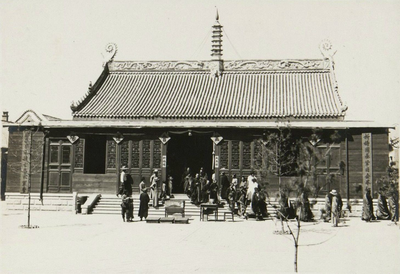
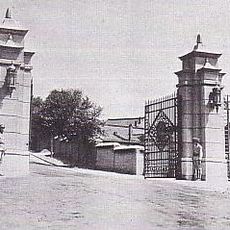
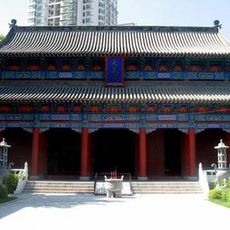
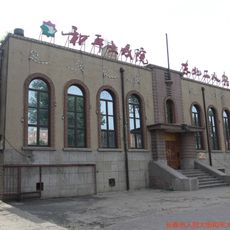
Huguo Banruo Temple occupies a 15,000-square-metre site at 337 Changchun Street, with 4,700 square metres of buildings in three successive courtyards. The south gate has three openings inscribed "Chanlin", "Qingjing" and "Huguo Banruo Temple"; inside stand the bell and drum towers, then the 240-square-metre Hall of the Four Heavenly Kings, the 484-square-metre Mahavira Hall with its 16-metre-square porch, and the two-storey Hall of the Three Sages of the West with a scripture library above.
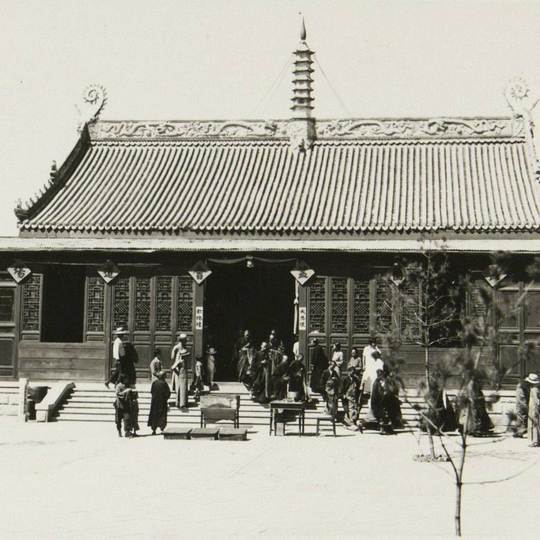
The temple was first built from 1926 at Dajing Road and Sanjing Road on land donated by Jiang Jieshan, and named after Tanxu's lectures on the Diamond Sutra. In 1931 the Japanese-controlled city government rerouted Datong Street and Bei'an Road through the site, forcing its complete demolition. Rebuilt at its present location, it was renamed Huguo Banruo Temple by Puyi in 1934 and the main halls were finished on 20 May 1936.
The main hall displays a central Buddha statue flanked by Guanyin and Arhat figures arranged along the walls. This layout follows a traditional pattern that creates a focal point for prayer and meditation.
The site welcomes visitors and operates under the Changchun Buddhist Association and the Buddhist Association of Jilin Province, which hosts regular religious activities. Guests should dress modestly and be aware of any ceremonies taking place during their visit.
In May 2004, workers building the Hongfa Hall dug up a well-preserved skull by the north wall of the rear courtyard. It was identified in December 2004 as the remains of Zhao Shangzhi, commander of the Third Army of the Northeast Anti-Japanese United Army, and reburied in his hometown in 2008.
The community of curious travelers
AroundUs brings together thousands of curated places, local tips, and hidden gems, enriched daily by 93,128 contributors worldwide.