Heligoland Düne Lighthouse, Maritime navigation aid on Heligoland island, Germany
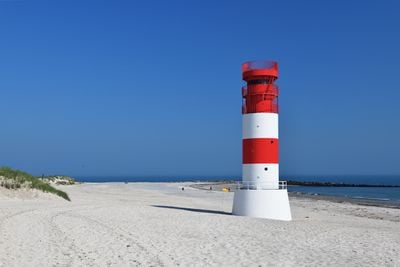
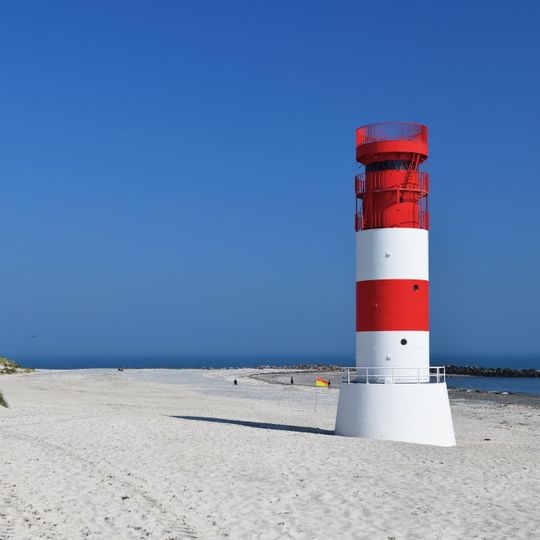
The Heligoland Düne Lighthouse is a 15-meter iron tower with white and red stripes serving as a navigation aid on the dune. It marks the shipping channels leading to the island's harbors in the North Sea.
Hamburg merchants kept a coal beacon on the Düne, then still joined to Heligoland, from 1663; a second fire, the Kapen-Feuer, stood to the south from 1656. Both were destroyed in 1720 when the island and dune broke apart. Around 1762 German shipowners set up two daymarks on Hog-Stan Sand and Steingrund, and a resolution of the first European sea-mark conference of 1926 led to the present tower, built in 1936.
The tower's name comes from the uninhabited island of Düne, which was still joined to Heligoland when Hamburg merchants kept a coal beacon there from 1663. The present light, run by the Wasserstraßen- und Schifffahrtsamt Elbe-Nordsee, still guides shipping into the Heligoland roadstead and harbours.
The structure emits white, red, and green sector lights that flash every four seconds to help ships navigate. The location is best visited during daytime, as the island is accessible only by boat or plane.
A 10-meter steel mast located 120 meters south of the tower functions as a lower light, forming a dual navigation system. This arrangement was essential for sailors to safely approach the island even in poor weather.
The community of curious travelers
AroundUs brings together thousands of curated places, local tips, and hidden gems, enriched daily by 93,196 contributors worldwide.