Helgoland lighthouse, Maritime lighthouse in Heligoland, Germany.
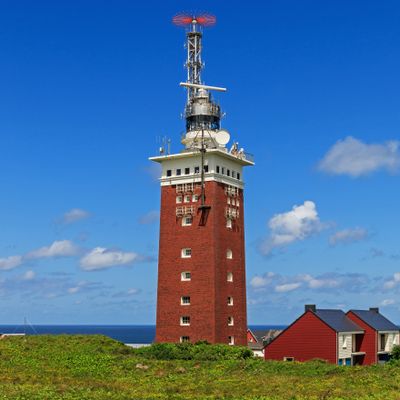
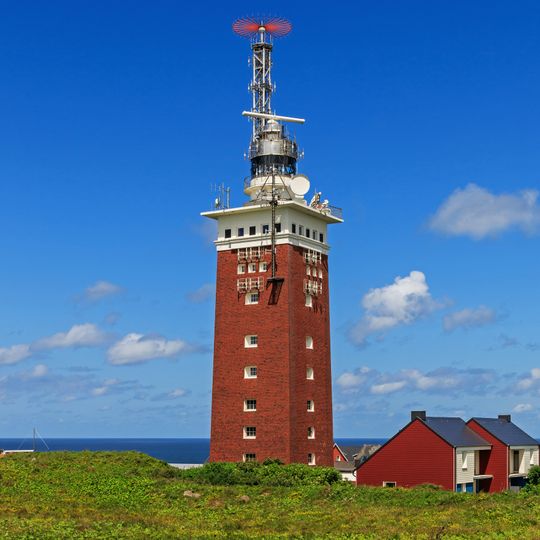
Helgoland lighthouse stands on the Oberland, the island's high plateau, beside a radio relay tower. Its square shaft of red brick, with rows of small rectangular windows and metal fittings, rises from a green slope to a white gallery level with dark openings, topped by a mast carrying a ring of red spikes, a white bar and dish antennas. The brick veneer dates from a 1965 renovation of the 1941 concrete anti-aircraft tower.
The first Heligoland light was set up in 1630 by the Duke of Schleswig, who levied 'fire money' from shipowners; it closed in 1637. Hamburg ran a coal-fired light from 1676, and in 1810–1811 the British built the 67-metre 'English lighthouse', whose lantern was later moved to Staberhuk on Fehmarn. A round brick tower of 1902, built to the plans of Cape Arkona, was destroyed by RAF bombing on 18 April 1945, killing its keeper. The present tower, a 1941 reinforced-concrete anti-aircraft and fire-control structure, became the lighthouse in 1952 and gained its brick facing in 1965.
The tower's name appears on two German postage stamps: a 30-pfennig stamp of 20 October 1972 from the Fremdenverkehr series, designed by Heinz Schillinger, and a 70-cent stamp of 6 July 2023 from the Leuchttürme series, designed by Carsten Wolff. The smaller Helgoland Düne light has been remote-controlled from here since 1982.
The lighthouse is best viewed and photographed from the harbor area or higher ground on the island. Visitors should be cautious in windy weather, as its exposed location means conditions can turn rough quickly.
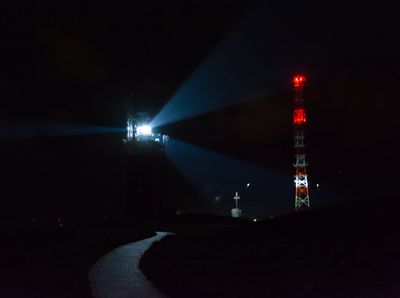
The lighthouse emits one of the strongest light beams on the German North Sea coast, visible to ships up to 28 nautical miles away. This range allows the beacon to illuminate waters toward multiple island chains in the region.
The community of curious travelers
AroundUs brings together thousands of curated places, local tips, and hidden gems, enriched daily by 94,532 contributors worldwide.