Heidelsburg, Castle ruins near Waldfischbach-Burgalben, Germany
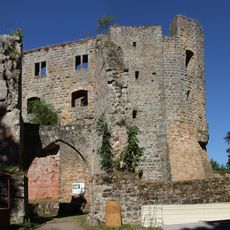
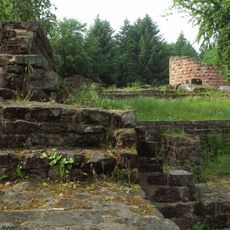
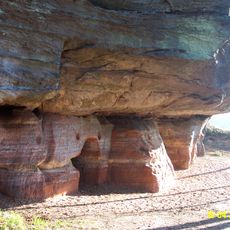
Heidelsburg is a ruined Roman fortification on a rocky spur of the Drei-Sommer-Berg above the Schwarzbachtal valley near Waldfischbach-Burgalben. Its oval perimeter wall of large sandstone ashlars incorporated natural rock faces and replaced an older wooden-post structure. Two gates, west and east, led into the camp; the west gate was rebuilt in the late 1920s from original blocks.
Roman coins found in the 1970s date the fortification to between the 2nd century AD and 351. A Gallic coin suggests a possible Celtic predecessor around 100 BC, and the chamber gate may indicate late Carolingian rebuilding. In 1355 Count Arnold of Homburg sold the Bunenstein rock to Count Walram II of Zweibrücken, who planned a castle and town there, but the project was never carried out.
The name Heidelsburg only arose in the Middle Ages, when the site had already been a ruin for centuries; it is related to "Heiden" (heathens). A grave slab found in the 19th century shows a man with an axe, symbol of the Roman forest manager (saltuarius), and a woman with a basket. The original is in the History Museum of the Palatinate in Speyer; a replica from 1876 stands at the find spot by the destroyed east wall.
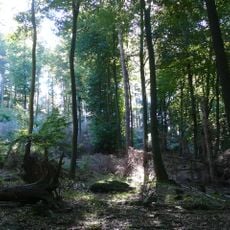
The ruins are accessible via marked hiking trails from Waldfischbach-Burgalben, with parking available at the forest entrance. The site is easy to reach on foot and offers views across the surrounding woodland.
The grave slab found in the 19th century shows a man with an axe and a woman with a basket; the axe was the emblem of the Roman forest manager, the saltuarius. The original is kept in the Historical Museum of the Palatinate in Speyer, while an 1876 replica stands at the find site by the ruined east wall.
The community of curious travelers
AroundUs brings together thousands of curated places, local tips, and hidden gems, enriched daily by 94,513 contributors worldwide.