Speyer Cathedral, Imperial Cathedral in Speyer, Germany.
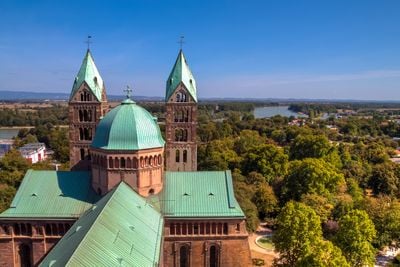
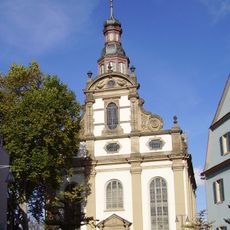
Speyer Cathedral is a Romanesque basilica of red sandstone in Speyer, Germany, with a west facade flanked by two square towers topped with green copper spires. A long body with a green copper roof and rows of small and large arched windows connects them, while on the right a large rounded green dome rises above an octagonal drum. Behind the dome stands a taller tower with a green roof, and trees partly cover the lower left and center.
Conrad II began the cathedral around 1025 and construction started in 1030 on a raised site above the Rhine, intended as the largest church of the Western world and his burial place. Conrad died in 1039 and was buried while the building was unfinished; Henry III followed in 1056. Consecrated in 1061, the cathedral was half demolished from about 1090 under Henry IV, who raised the nave by five metres and replaced the flat wooden ceiling with groin vaults. The rebuilt church was complete in 1106.
The name reflects its role as the burial church of Salian emperors, whose legacy shaped the building for centuries. Visitors walking through the nave notice rows of columns and the high ribbed vaults that convey imperial authority.
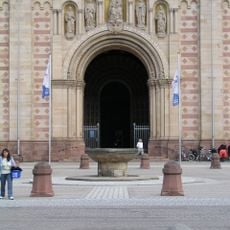
The main entrance is on the west side, under the two facade towers; the nave opens beyond it. The crypt of Speyer I lies beneath the choir and is reached by stairs there. The building stands on an elevated plateau above the Rhine, safe from high water.
The crypt houses eight emperors and four queens in stone sarcophagi, forming the largest Romanesque burial chamber in Europe. Above the entrance runs a continuous gallery, first used in medieval architecture here.
The community of curious travelers
AroundUs brings together thousands of curated places, local tips, and hidden gems, enriched daily by 94,045 contributors worldwide.