Bamberg Cathedral, Catholic cathedral in Bamberg, Germany.
Bamberg Cathedral is a late Romanesque church with four towers, each about 81 m high, a nave 94 m long, 28 m wide and 26 m high. Its pale stone walls have rows of arched windows, round windows below and small dormer windows on the dark roof. Two towers with green pointed spires stand on the left, two with dark pointed roofs on the right; a gold clock face is mounted on the left tower.
Henry II laid the foundation stone in 1004, and the first cathedral was consecrated on his birthday, 6 May 1012. It burned in 1081 and again in 1185; the present late Romanesque building was erected under bishops Otto, Ekbert and Poppo of the House of Andechs-Merania and consecrated on 6 May 1237.
The cathedral's double patronage, Peter and George, was chosen to link the Roman and Byzantine churches; Mary stands for what both share. On 15 August, the Assumption is marked in Bamberg with a procession of four stations. The first organ is recorded in 1415; the present instrument dates from 1976.
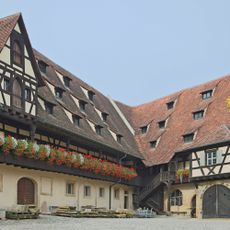
The main entrance is the round-arched portal with the zigzag molding and the shield bearing a blue cross, reached by a broad flight of stone steps; six statues stand in two groups of three beside the door. The cathedral lies on the Domberg, surrounded by the chapter house, the Alte Hofhaltung and the Neue Residenz, so the square is reached on foot uphill from the old town. Balthasar Neumann built the chapter house with its administration offices in 1729–33.
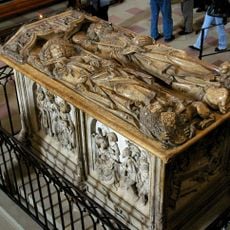
The tomb of Pope Clement II, who died in 1047, is the only papal grave north of the Alps; the tombs of Benedict V in Hamburg and other popes lie in France or Italy. The founder's tomb by Tilman Riemenschneider, carved 1499–1513, shows Henry II and Cunigunde on its lid.
The community of curious travelers
AroundUs brings together thousands of curated places, local tips, and hidden gems, enriched daily by 92,665 contributors worldwide.