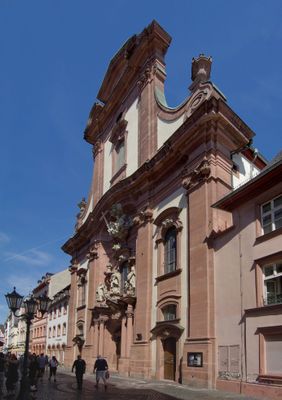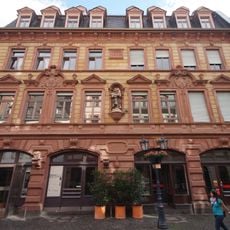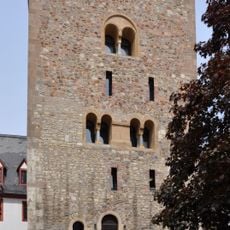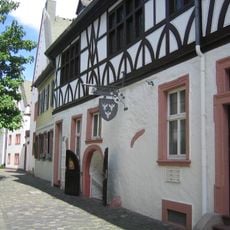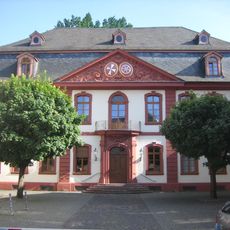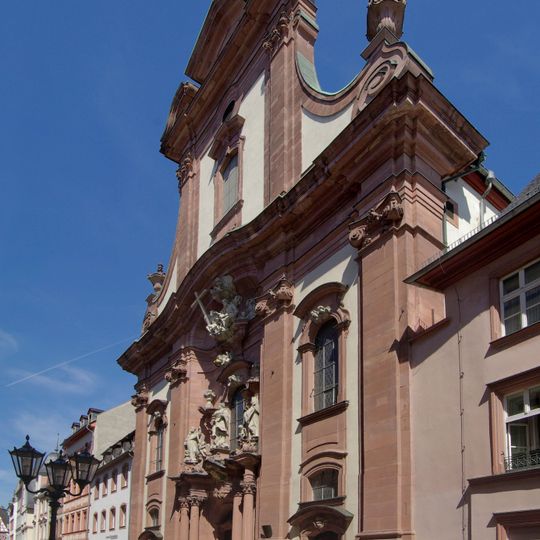
St. Augustine's church, Baroque church in Altstadt, Mainz, Germany.
St. Augustine's Church is a baroque church in Mainz's Altstadt featuring a tall facade that rises above the surrounding historic buildings. The architecture displays the regional Main-Franconian baroque style with carefully detailed facade elements and ornamental designs.
The Augustinian hermits replaced their Gothic church of 1260 with the present building, erected between 1768 and 1771 by an unknown master mason. Their community lasted until the secularization of 1803, when the monastery was dissolved. In 1805 the complex became the seminary of the newly re-established Diocese of Mainz, and the church became its seminary church. It survived World War II bombing that destroyed much of the surrounding Altstadt.
The nave fresco of 1772 by Johann Baptist Enderle shows the Virgin and Child enthroned, with Augustine offering his burning heart. Four inscriptions around it name his roles: Doctor of the Church at the east, Patriarch of Religious at the west, Hammer of Heretics at the south and Disciple of Truth at the north. Among the listeners at the west is Hugo Franz Karl Count of Eltz, who funded the frescoes.
The church is set back from Augustinerstrasse, enclosed by the former convent and seminary buildings, so only its towerless facade is visible from the street. Visitors enter through the portal beneath Nikolaus Binterim's sculpture group; the interior is used for seminary services, so access may be limited during those times.
The Stumm organ of 1773 has 34 stops on two manuals and pedal, not 31 as often stated. Its smallest bell was melted down in World War I; in 2011 Günter Schneider found a matching Baroque bell by Georg Christoph Roth in St. Georg, Mainz-Bretzenheim, and it was loaned to restore the three-bell Baroque peal.
The community of curious travelers
AroundUs brings together thousands of curated places, local tips, and hidden gems, enriched daily by 94,947 contributors worldwide.