Zum Römischen Kaiser, Renaissance architecture hotel at Liebfrauenplatz, Mainz, Germany
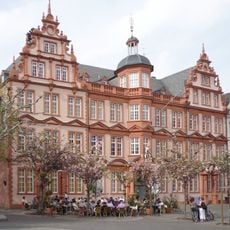
Zum Römischen Kaiser is a three-storey stone palace on the north side of Liebfrauenplatz in Mainz, built in two phases in the second half of the 17th century. Its five-axis central block and two three-axis side wings carry volute gables topped by shells; the west gable is divided by half-columns on pedestals, the east gable lacks them. Above the main portal, framed by two Tuscan columns on lion-head pedestals, an oriel rises as an octagonal tower with a lantern; the crowned figure in plate armour, sceptre and ermine, with a Turk's head and cannonballs at its feet, probably represents Emperor Charles VI.
Edmund Rokoch, a wholesale merchant and electoral financial official, built the palace in two phases: the western part around 1657 and the eastern wing with the central block by 1664. It was the first major new building in Mainz after the Thirty Years' War and served as a model for later noble residences such as the Bischöfliches Palais and the Schönborner Hof.
From 1742 the palace was run as the hotel Zum Römischen Kaiser, the name it still bears. Its guest list included Mozart, Voltaire and Goethe. The name comes from the figure above the portal, a man in armour, ermine and crown, probably Emperor Charles VI, with a Turk's head and cannonballs at his feet.
The building has housed the Gutenberg Museum since 1930, focusing on printing technology and the history of books. Plan to spend several hours exploring the extensive collection and specialized research library.
The vaulted passage behind the main portal carries heavy stucco work: putti on the ribs hold rosettes at the keystones, and the webs show birds, some of grotesque shape. In the passage stands a sandstone monument to Johannes Gutenberg made by Joseph Scholl in 1827.
The community of curious travelers
AroundUs brings together thousands of curated places, local tips, and hidden gems, enriched daily by 92,894 contributors worldwide.