Gutenberg-Museum, Printing museum in the old town of Mainz, Germany
The Gutenberg Museum is a collection dedicated to the history of printing and book production in Mainz. The exhibition displays printing presses, ancient manuscripts, and two original copies of the famous 42-line Bible, kept in a secure vault.
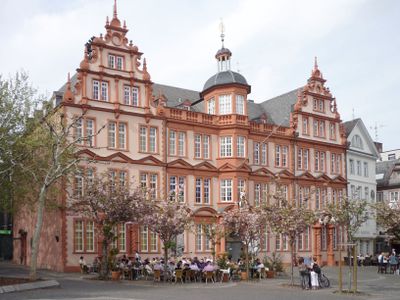
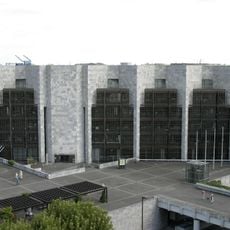
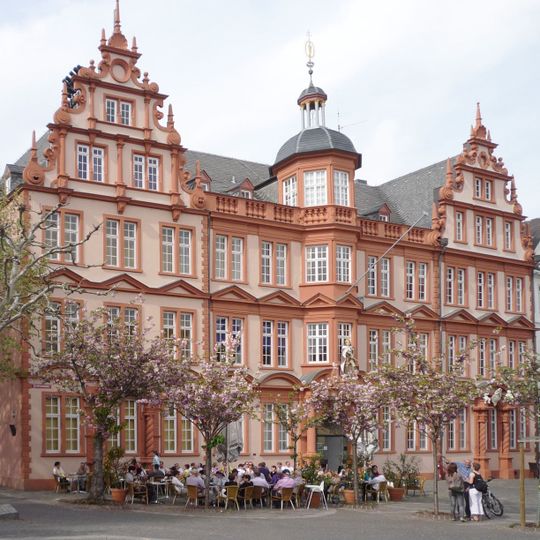
Citizens of Mainz founded the museum in 1900, and it opened on 23 June 1901. It began in two rooms of the Kurfürstliches Schloss, moved to the Rheinallee library building in 1912, and to the Zum Römischen Kaiser house in 1926, taking over the whole building by 1932. The Römischer Kaiser was bombed in 1945, though the collections had been stored safely; after restoration a new exhibition building by architect Rainer Schell opened in 1962.
The museum is named after Johannes Gutenberg, who invented printing with movable metal type in Mainz. Its collection began with donations from publishers, press manufacturers and printing houses, and in 1925 a reconstruction of Gutenberg's workshop was installed, where type founding, typesetting and printing are demonstrated.
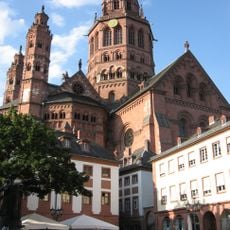
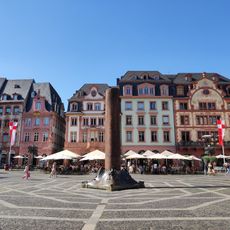
Since 23 November 2024 the museum's interim exhibition, Gutenberg-Museum MOVED, occupies renovated rooms in the Naturhistorisches Museum near Liebfrauenplatz, while the Schell building opposite the cathedral is replaced by a new building. The entrance gates of the old Schell building were made by sculptor Karl-Heinz Krause. Allow time for the printing demonstration and the vault with the Bibles.
The bookplate collection grew from a few dozen examples to around 100,000 after collector Willy Tropp donated roughly 50,000 in 1963. Among the ex-libris are marks made for Charles Lindbergh, Albert Einstein, Charles Dickens, Franklin D. Roosevelt and Adolf Hitler.
The community of curious travelers
AroundUs brings together thousands of curated places, local tips, and hidden gems, enriched daily by 93,698 contributors worldwide.