Neuscharfeneck Castle, Rock castle in Ramberg, Germany
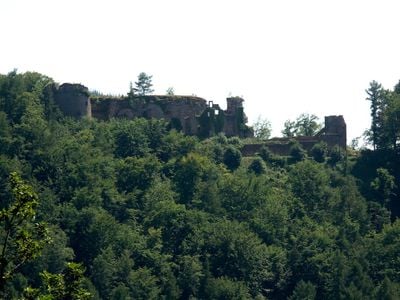
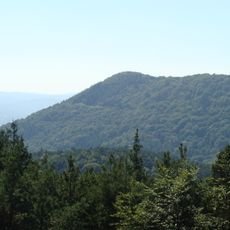
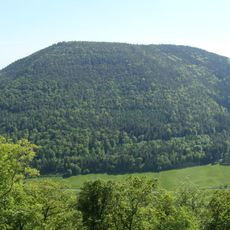
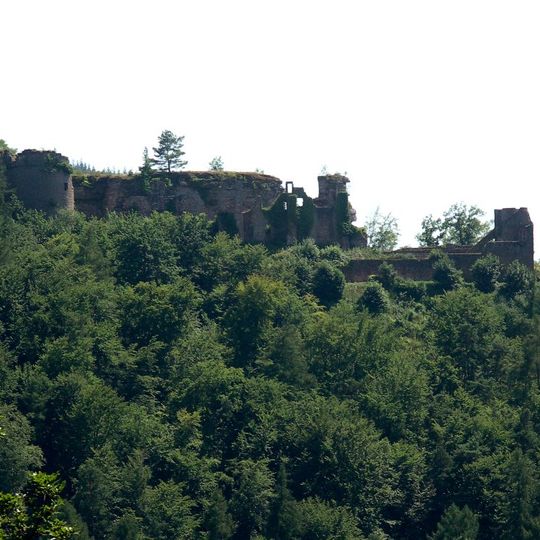
Neuscharfeneck Castle is a fortress in Ramberg built directly into the rocky hillside along the western slopes of Kalkofen Berg. The structure consists of chambers and defensive walls carved into the natural stone, creating a compact fortified complex.
The castle was probably not founded around 1232 by Johann von Scharfeneck, as a 16th-century forged charter claims. The Scharfeneck-Metz family, a branch of the older Scharfeneck line, held it as a fief of the Electors Palatine from 1363. In 1416 it passed to the Wittelsbach electors, and in 1525 the Nußdorf band burned it during the Palatine Peasants' War. Swedish troops blew it up in 1633 during the Thirty Years' War.
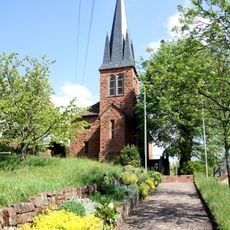
The castle name Scharfeneck refers to the Scharfeneck family, whose coat of arms showed a crowned silver lion on a red field. Heinrich III of Scharfeneck dropped the epithet Metz and founded a new Gothic church in Dernbach. In 2013 Prince zu Löwenstein-Wertheim-Rosenberg visited the ancestral castle of his forebears and was received by the Scharfeneck Society.
Reaching the fortress requires climbing steep paths through rocky terrain, so visitors should come prepared for uphill walking. Good footwear and adequate fitness help when exploring the site and its surrounding area.
The fortress contained a system of rock-carved basins designed to collect rainwater and spring water, ensuring self-sufficiency during long periods without outside supply. This engineering solution shows how carefully the builders planned for extended occupation.
The community of curious travelers
AroundUs brings together thousands of curated places, local tips, and hidden gems, enriched daily by 93,620 contributors worldwide.