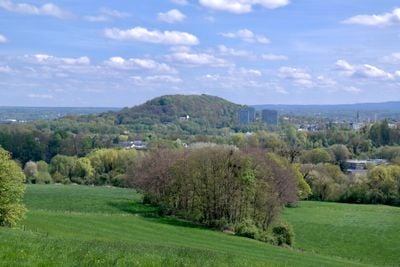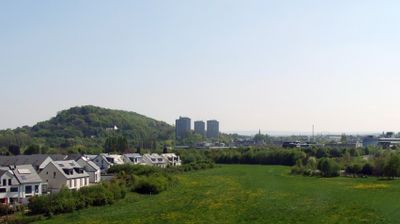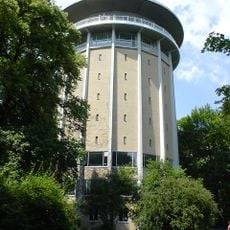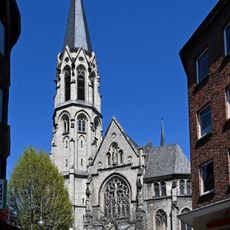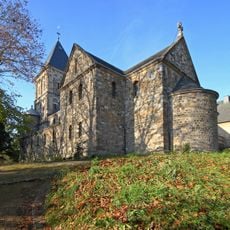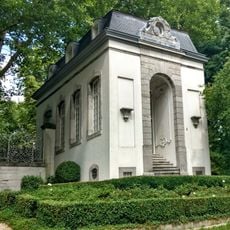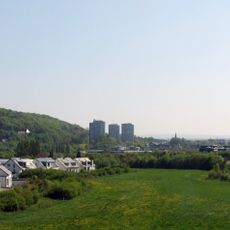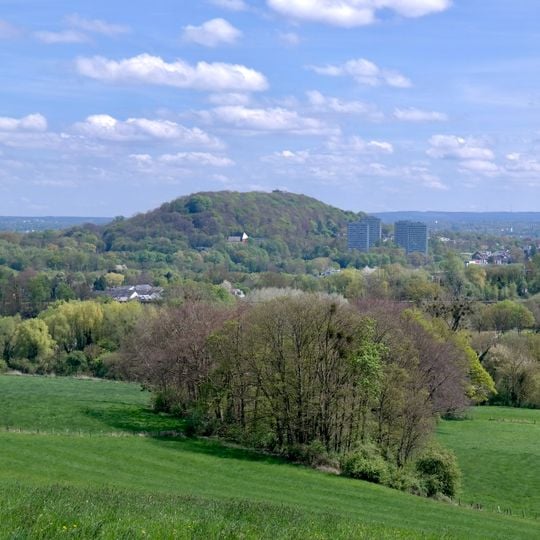
Lousberg, Landscape garden and hill in Aachen, Germany.
Lousberg is a hill with a landscape garden in Aachen that rises about 264 meters above the city. The mountain features walking trails throughout, designed green spaces, and several viewpoints where you can look out over the surroundings.
Neolithic miners worked flint on the Lousberg between 3500 and 3000 BC, quarrying a grey stone with chocolate-brown bands. Radiocarbon dates from the overburden place the mine in that span, and calculations suggest about 300,000 axe blanks left the hill, reaching Thieusies in Belgium and Büdingen in Hesse. Roman builders later used its limestone for Aachen's thermal baths, and medieval masons for the Barbarossa Wall.
The name Lousberg is not fully explained: it may come from the Aachen dialect word lousen ("to look") because of the view, or from Louis the Pious, son of Charlemagne. Another reading links it to lous, Aachen dialect for "clever". The hill has served as a forest and mountain park since the early 19th century.
The Lousberg rises to 264 metres on the northern edge of Aachen's historic centre; paths cross the plateau and descend the slopes, and cracks in the footpaths and leaning trees on the flanks show where the loose dumped limestone still slips. The plateau holds a stand of yew, and wild daffodils grow in the Müschpark, the listed former St. Raphael monastery park to the north.
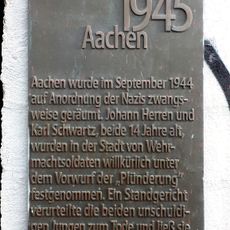
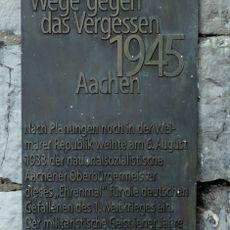
The obelisk on the Lousberg was erected on 17 October 1807 by the French Ministry of War to honour the geographer Jean Joseph Tranchot, whose triangulation survey of the Rhineland began from a point on this hill. It was destroyed on 2 April 1814, when Napoleon was deposed.
The community of curious travelers
AroundUs brings together thousands of curated places, local tips, and hidden gems, enriched daily by 93,601 contributors worldwide.