Old Academy, Renaissance architectural monument in Münchner Altstadt, Germany.
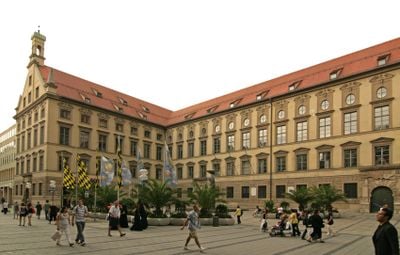
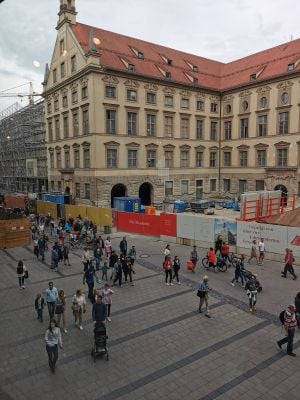
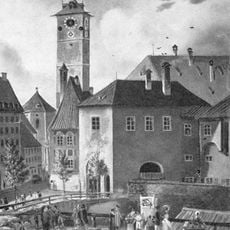
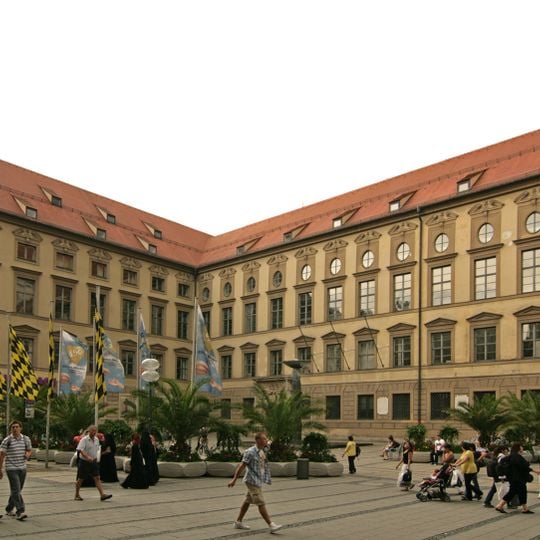
The Old Academy, also called Wilhelminum, is a partly six-storey Renaissance complex in Munich's old town, built around four inner courtyards: the Zierhof, Klosterhof, Schmuckhof and Wirtschaftshof. Its L-shaped wings enclose a paved square; the lower levels are pale beige stone with rows of rectangular windows, the upper storeys ochre-yellow with round windows in decorative surrounds alternating with tall rectangular ones. Red tiles cover the steep roof, pierced by small dormers, and the facade rises straight from the paving behind a row of small trees.
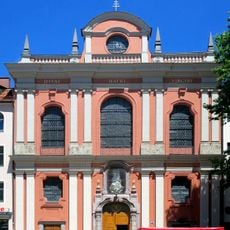
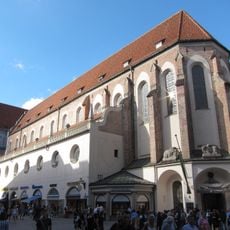
The building was commissioned in 1583 by Duke William V of Bavaria and initially served as a Jesuit school and college next to St. Michael's Church. Over the centuries its functions shifted repeatedly, reflecting the changing needs of the city.
The name Alte Akademie comes from the Bayerische Akademie der Wissenschaften, housed here from 1783, and the Academy of Fine Arts, based here from 1807. The building is also called Wilhelminum after Duke William V, who funded the Jesuit college. Four courtyards—Zierhof, Klosterhof, Schmuckhof and Wirtschaftshof—retain their names and layout.
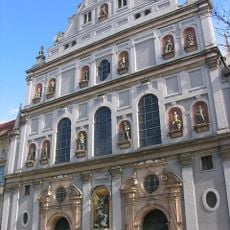
The building has been under renovation since 2020, with work halted in 2023, so the interior courtyards and shops are not open to visitors. The exterior can be seen from the surrounding streets of the old town, between Neuhauser Strasse and the Kapellenstrasse near St. Michael's Church.
The dinosaur fossils Ernst Stromer von Reichenbach found in Egypt were kept in the museum housed here, and Hans Krieg, its director, ignored Stromer's wish to move them to a safe place; they were destroyed in the April 1944 air raid. Only 16 window bays of the south wall survived the war, and Josef Wiedemann rebuilt the complex following the old structures.
The community of curious travelers
AroundUs brings together thousands of curated places, local tips, and hidden gems, enriched daily by 94,632 contributors worldwide.