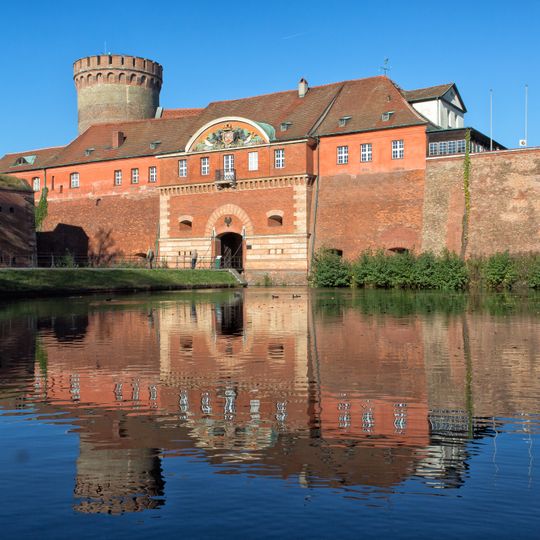
Spandau Citadel, Renaissance fortress in Haselhorst, Berlin, Germany.
The Spandau Citadel sits on a man-made island where the Havel and Spree rivers meet and shows high defensive walls with four projecting bastions. The complex forms a closed square with an inner courtyard, red brick buildings, and a medieval tower that is the oldest surviving part of the site.
Preparatory work on the fortress began in 1557, and construction started in 1560 under Joachim II Hector, who engaged Christoph Römer to build an Italian-style fortress around the older castle, Palas and Julius Tower. Francesco Chiaramella de Gandino took over in 1562, Rochus Graf zu Lynar in 1578. The first troops were assigned in 1580, and the work was completed in 1594.
The fortress now shelters around forty artist studios in what is called House 4, where visitors sometimes meet the artists at work. The arsenal building stores important sculptures from Berlin parks that once decorated public spaces and are now protected from weather damage.
Visitors can explore the grounds on their own or join guided tours that lead through the casemates and onto the bastions. The inner courtyard is used for concerts and events during summer, while several exhibition rooms remain accessible year-round.
The Julius Tower's crenellated top was designed by Karl Friedrich Schinkel in 1838. After the Franco-Prussian War of 1870/71, 120 million marks in French gold coin reparations were stored in the tower until their return in 1919. Since then, Germans have used the word Juliusturm for government budget surpluses.
The community of curious travelers
AroundUs brings together thousands of curated places, local tips, and hidden gems, enriched daily by 92,781 contributors worldwide.