Wiblingen Abbey, Benedictine monastery in Wiblingen, Germany.
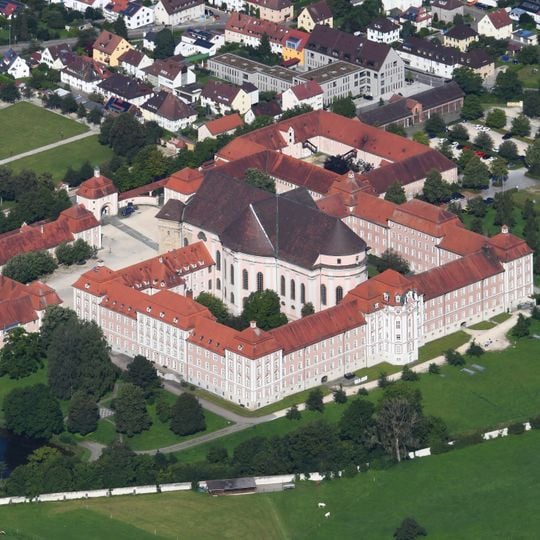
Wiblingen Abbey is a former Benedictine monastery of pale plastered walls and red tile roofs. Its tall church has a rounded apse and a steep dark hipped roof, with a small curved-top tower on the left wing. A long four-storey wing with rows of rectangular windows and a central roof turret adjoins the front courtyard.
Founded in 1093 by Counts Hartmann and Otto von Kirchberg, the abbey was settled by monks from St. Blaise's Abbey, with Werner von Ellerbach as first abbot. A fire destroyed it in 1271, and the rebuilt Romanesque basilica was consecrated in 1275. Under Abbot Ulrich IV Hablüzel (1432–1473) monastic discipline was reformed, and in 1504 the abbey came under Habsburg rule. The church was rebuilt from 1768 under Abbot Roman Fehr.
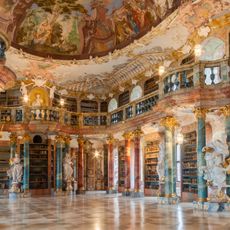
The abbey library, completed in 1744 in the north wing, was designed by Christian Wiedemann and finished under his nephew Johann. Its ceiling frescoes and carved figures are among the finest Rococo interiors in Upper Swabia. The room served the monks' scholarly work, and the abbey's name appears as Guibelinga in a 1098 papal document.
Visitors can explore the monastery through guided tours, while portions remain in use by the Medical Faculty of the University of Ulm. It is wise to check current opening hours and available tours before planning your visit.
The abbey's most prized relic, a splinter of the Holy Cross given by the founding counts, was walled up during the Thirty Years' War to save it from Swedish troops. The witnesses died of plague, and the hiding place was forgotten until the relic was rediscovered years later.
The community of curious travelers
AroundUs brings together thousands of curated places, local tips, and hidden gems, enriched daily by 94,112 contributors worldwide.