Zwangsarbeiterlager Neuaubing, Forced labor camp memorial in Aubing, Munich, Germany
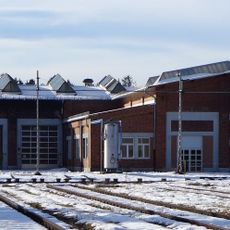
The Zwangsarbeiterlager Neuaubing is a preserved forced-labor camp built by the Deutsche Reichsbahn at the western edge of Munich-Neuaubing, just west of the 1937–1939 Gößweinsteinplatz settlement. Eight of the original eleven single-storey barracks survive, mostly in brick with tiled roofs, grouped around a long rectangular roll-call square; two concrete Moll splinter shelters stand at their original spot.
The Reichsbahnneubauamt of the Reichsbahndirektion München drew up plans for the "Barackenlager RAW Neuaubing" in November 1942; the camp was finished in December 1942 and approved by the Regierungspräsidium in February 1943. Six accommodation barracks, each a double block of two rooms, were calculated for 624 people, but rooms were massively overcrowded with forced labourers from Russia, Belarus, Ukraine, Poland, Italy, the Netherlands and France, with a peak of about 1,000. After the war it served as a refugee shelter, then from the 1950s as housing for railway employees and a Deutsche Bundesbahn apprentice hostel.
The site's name comes from the Reichsbahn repair works it served, and the address Ehrenbürgstraße 9 is now owned by the City of Munich. Since the 2010s artists and craftspeople have grouped in the association "Freie Ateliers & Werkstätten Ehrenbürgstraße" and use most barracks as studios, workshops, offices and flats, while one former guard barrack houses a kindergarten.
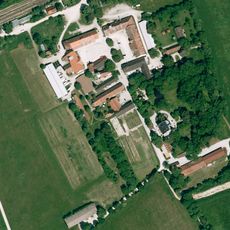
The grounds at Ehrenbürgstraße 9 lie at the western edge of Neuaubing, just west of the 1937–1939 Gößweinsteinplatz estate and a few hundred metres north of the Pasing–Herrsching railway line. The site is heavily overgrown and uneven, with a low mound of rubble from a demolished barrack on the former roll-call square. A branch of the NS-Dokumentationszentrum München is planned for 2025.
The flat mound on the former roll-call square is made of rubble from the demolished north-western barrack. Two RL3-42/143 splinter shelters by the Leonhard Moll concrete works still stand in their original positions, though three of their four entrances are buried.
The community of curious travelers
AroundUs brings together thousands of curated places, local tips, and hidden gems, enriched daily by 94,420 contributors worldwide.