Altenburg Castle, Medieval castle and museum in Altenburg, Germany.
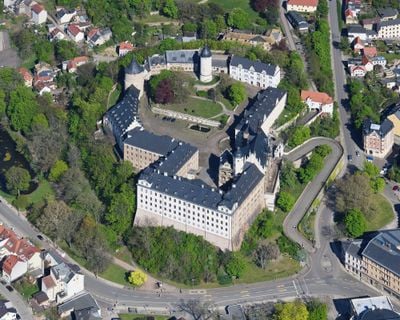
Schloss Altenburg rises on a porphyry rock above Altenburg, its west wing built as the baroque Corps de Logis between 1706 and 1744, with a slate roof and dormer windows. The complex joins an octagonal tower with a pointed roof, a taller domed tower, and a stone bridge with arched openings. The castle church St. Georg, built 1404–1414, has a late Gothic star vault and stands on a terrace.
A Slavic rampart preceded the castle, first mentioned in 976 under Otto II. Frederick Barbarossa expanded the imperial palace and in 1180 enfeoffed Otto of Wittelsbach with Bavaria there. The Wettins took over in 1307; in 1455 Kunz von Kauffungen abducted princes Ernst and Albrecht. Rebuilt as a palace between 1706 and 1744, it served as the residence of the dukes of Saxe-Altenburg from 1826 to 1918.
The castle was home to the dukes of Saxe-Gotha-Altenburg, and their collections still shape how the rooms look today. The furnished chambers show how the ruling family lived and displayed their power.
Visits are possible Tuesday through Sunday and public holidays from 09:30 to 17:00, with each museum room accessible via corridors from the outside. There are stairs between different floors, so visitors with mobility challenges should check ahead.
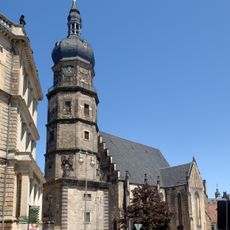
The castle church of St. Georg, built 1404–1414, holds the Trost organ, completed in 1739 by Tobias Heinrich Gottfried Trost. Johann Sebastian Bach and Johann Ludwig Krebs played on it; Krebs served as organist here from 1756 to 1780. The instrument's contract of 13 August 1739 specified a 32-foot trombone stop, a cornet and a glockenspiel.
The community of curious travelers
AroundUs brings together thousands of curated places, local tips, and hidden gems, enriched daily by 93,595 contributors worldwide.