Museum Brandhorst, Art museum in Maxvorstadt, Munich, Germany.
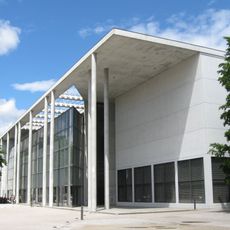
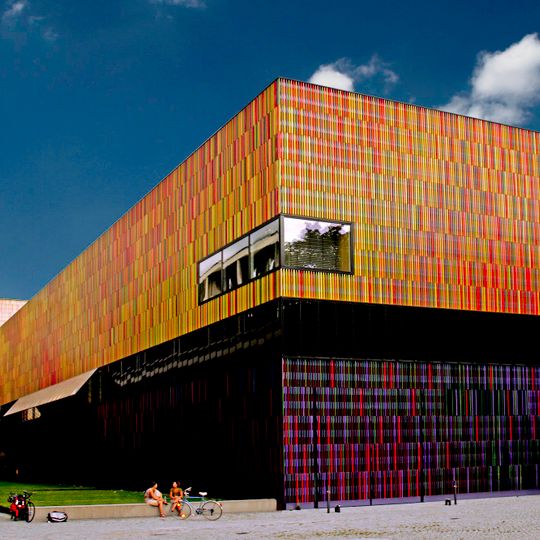
Museum Brandhorst is an art museum in Maxvorstadt, Munich, built by Sauerbruch Hutton on the site of the former Türkenkaserne and opened in 2009. Its facade carries 36,000 vertical ceramic rods in 23 glazes, arranged in three colour families: yellow and orange tones above, saturated blues, reds, purples and greens below, with a continuous band of dark glass windows between them. Behind the rods sits perforated folded sheet metal that absorbs traffic noise. The building joins a two-storey rectangular hall to a taller head block widened toward the north.
Anette Brandhorst, great-granddaughter of Henkel's founder, and her husband Udo began collecting art in 1971. After Anette died of cancer in 1999, Udo donated the collection to the state of Bavaria on condition that it build a home for it. Bavaria funded construction, and the museum was inaugurated on 18 May 2009 and opened on 21 May 2009.
The name honors the Munich collectors who made their private holdings accessible to the public, establishing a focus on American postwar art. Visitors today encounter mainly Pop Art and contemporary works that show the dialogue between European and American artistic circles over recent decades.
The building sits just a few minutes on foot from Theresienstrasse subway station and is barrier-free. On site there is a bookstore with art volumes and a cafe for breaks between exhibition rounds.
A dedicated room on the upper floor houses a monumental painting cycle presented in relative silence and subdued light. The walls were designed specifically for these twelve large canvases, so viewing them feels almost meditative.
The community of curious travelers
AroundUs brings together thousands of curated places, local tips, and hidden gems, enriched daily by 93,962 contributors worldwide.