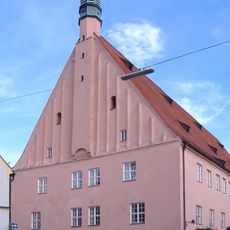
Alte Anatomie, Historical medical building in Ingolstadt, Germany
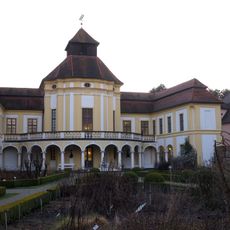
The Alte Anatomie is a two-story baroque building with pilasters, cornices, a mansard roof, and a central pavilion topped with a tower-like crown. It now houses the German Museum of Medical History, which presents exhibitions about how medicine and science developed over many centuries.
The medical faculty of the University of Ingolstadt commissioned this building from Eichstätt court architect Gabriel de Gabrieli; construction ran from 1723 to 1736, financed largely by donations. The amphitheatre-like lecture hall received its baroque ceiling fresco by Melchior Puchner at completion. Damaged in 1745 during the War of the Austrian Succession, it served the faculty until the university moved to Landshut in 1800, after which it decayed and was even used as a farm.
The lecture hall's ceiling carries a baroque fresco completed by Melchior Puchner in 1736, the year the building was finished. The garden laid out on the building's axis was replanted in 1777 according to Linnaeus's system with medicinal and spice plants, a hortus medico botanicus. The university moved to Landshut in 1800, ending the medical faculty's use of the house.
The building is located at Anatomiestraße 18-20 and can be visited as it now functions as a museum. Visitors can walk through the rooms and see how medical teaching and learning were organized in this space.
The botanical garden was laid out in 1685, not 1722, and was redesigned in 1777 on Linnaeus's classification system; it held medicinal and spice plants as a hortus medico botanicus. It lies on the building's axis, running northeast of the pavilion.
The community of curious travelers
AroundUs brings together thousands of curated places, local tips, and hidden gems, enriched daily by 93,875 contributors worldwide.