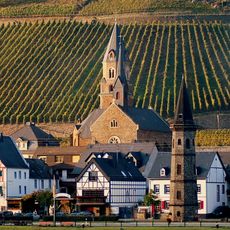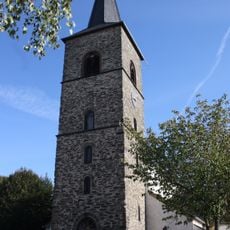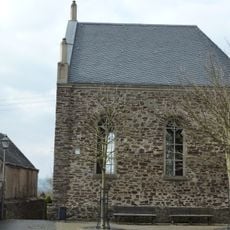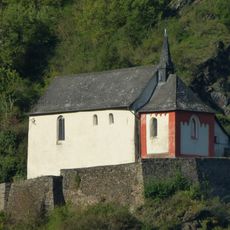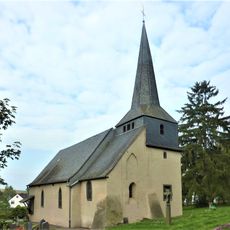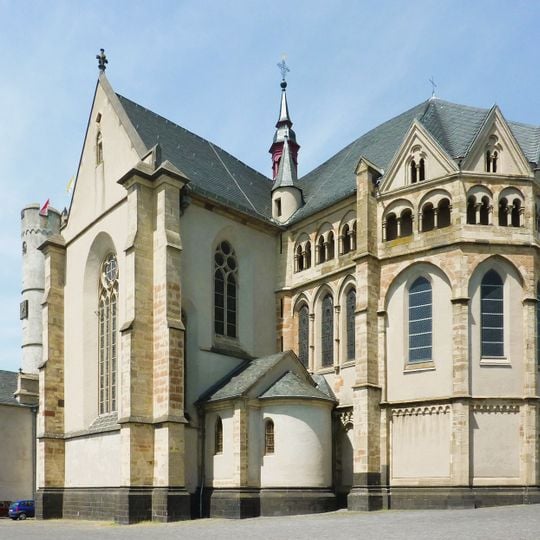
Stiftskirche Münstermaifeld, Collegiate church in Münstermaifeld, Germany
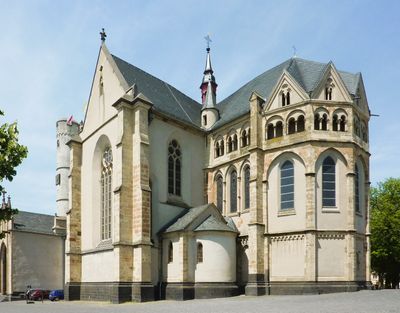
Stiftskirche Münstermaifeld, also called Maifeldmünster, is a former collegiate church built between 1225 and 1322 in the Rhineland transitional style. Its westwork is a 34-metre double tower whose lower part survives from the Romanesque predecessor consecrated in 1103; the Gothic fourth storey with crenellations and oriel windows was added in the 14th century to house a new bell frame. The choir, begun in the 13th century, is a polygonal late-Romanesque structure with side apsides, while the transept and nave are High Gothic. The church measures 51 metres long, with a transept 29 metres wide and a choir 20 metres high.
A Merovingian foundation of the 6th or 7th century, the church was consecrated in 640 by Archbishop Modoald of Trier and became a monastery church shortly after 700. It was first recorded as a collegiate church in 905. In 952 Archbishop Ruotbert brought relics of the priest Severus from Italy to Trier, later translated to Münstermaifeld, making the town a pilgrimage centre.
The interior wall paintings from the 13th to 15th centuries depict religious scenes that visitors encounter while walking through the church. These frescoes offer insight into the faith and artistic expression of earlier generations.
The south entrance is sheltered by a porch holding three sculptures: Saints Martin and Severus outside and a Madonna of around 1320 above the central pillar. The church measures 51 m in length, with a 29 m-wide transept and a west tower reaching 40 m.
In the north aisle stands the Holy Sepulchre, carved around 1500: seven figures of tuff stone around the buried Christ, above them a Man of Sorrows between four angels holding the instruments of the Passion. Its style links it to the Holy Sepulchres of Andernach's Liebfrauenkirche and Sinzig.
The community of curious travelers
AroundUs brings together thousands of curated places, local tips, and hidden gems, enriched daily by 94,117 contributors worldwide.