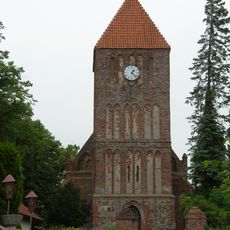
Charenza, Medieval castle ruins in Vorpommern-Rügen, Germany.
Charenza is a Slavic burgwall on Rügen, now called Venz Castle, near Venz in the Trent municipality. Its surviving rampart rises up to 10 m, enclosing an inner area of about 25,000 m². The surrounding meadows and marshes lie only about 2 m above sea level, while the interior is 4 to 6 m high.
Charenza was the seat of the Rani princes and a temple site with shrines to Rugievit, Porevit and Porenut. In 1168, after Arkona fell to King Valdemar I of Denmark and Archbishop Absalon, the burgwall surrendered without a fight following talks with princes Tezlaw and Jaromar. The temples were destroyed, mass baptisms took place, and the princes became Danish vassals. Around 1180 the administrative centre moved to Rugard.
The site served as a religious center for Slavic peoples before Christianity reshaped the region. The ruins show how two distinct cultures left their marks at this location one after the other.
The site is reached via marked paths starting from Venz village, leading to the visible remains on the elevated ground. Information panels along the way help visitors understand the structure and its historical role.
The last written document mentioning the castle dates to 1237 and shows it was still used for regional administrative tasks. After that date, the location disappears from historical records.
The community of curious travelers
AroundUs brings together thousands of curated places, local tips, and hidden gems, enriched daily by 94,151 contributors worldwide.