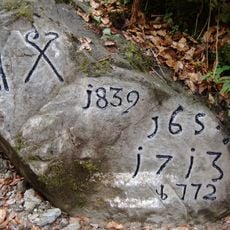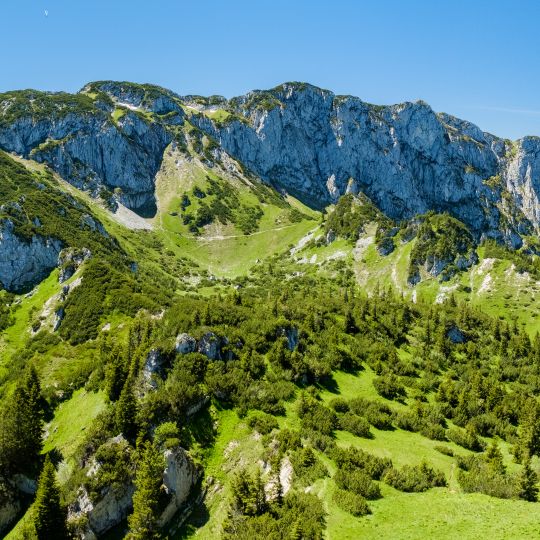
Benediktenwand, Mountain ridge in Bavaria, Germany.
Benediktenwand is a mountain ridge in Bavaria stretching between the Loisach and Isar rivers, reaching 1,801 meters in elevation. Its north face displays striking limestone formations that shape the massif and remain visible from great distances.
The ridge was recorded around 1300 as 'montem sancti Benedicti', the source of its name from Benediktbeuern Abbey. During the Würm glaciation its summit stood about 600 m above the ice of the Walchensee and Isar glaciers. The first summit cross was raised in 1877 after four woodcutters' vow, and has been renewed in 1897, 1919, 1930, 1958 and 2023.
The name Benediktenwand comes from Benediktbeuern Abbey, dedicated to Saint Benedict; around 1300 the ridge was recorded as montem sancti Benedicti. A folk tale collected by Johann Nepomuk Sepp says the mountain rests on four golden columns and hides immense treasures, and that a boy from Wackersberg found a spring bubbling with gold. A bronze tablet above the Bichler Alm, designed by Josef Oswald, tells the story of the ibex colony.
The mountain is accessible from Benediktbeuern via several routes, with the longest covering around 23 kilometers and gaining about 1,122 meters (3,680 feet). Visitors should prepare for changing weather at elevation and bring sturdy footwear along with plenty of water.
The first Alpine ibex was spotted by mountain walkers in September 1959, but the colony began with two billy and two nanny goats brought from Switzerland in June 1967. A bronze tablet at the start of the Altweibersteig above the Bichler Alm, unveiled in 2004, records this history and names the sponsors Alfons Goppel, August Moralt and Franz Burda.
The community of curious travelers
AroundUs brings together thousands of curated places, local tips, and hidden gems, enriched daily by 94,433 contributors worldwide.