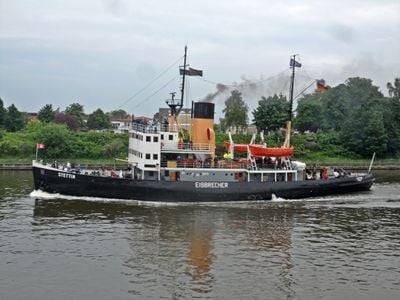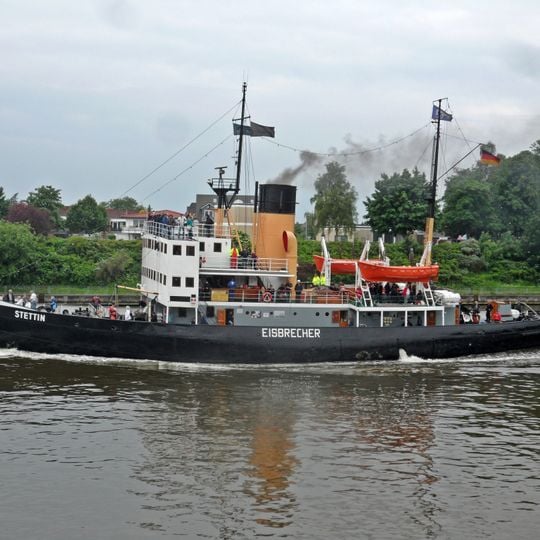
SS Stettin, Steam icebreaker in Oevelgönne museum port, Germany
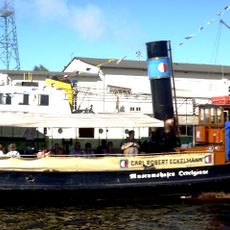
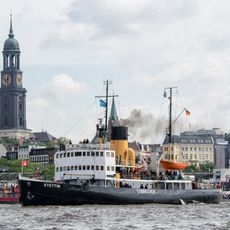
The SS Stettin is a coal-fired steam icebreaker with a black hull, white superstructure and a black smokestack with a yellow lower section. Its bow carries the Runeberg-steven, a sharp cutting edge that split ice rather than crushing it by weight. The name STETTIN appears in white on the port bow and EISBRECHER on the midship hull.
Stettin was laid down on 31 August 1932 at the Stettiner Oderwerke (hull no. 769) and completed on 16 November 1933 for the Stettin Chamber of Commerce, costing 574,000 Reichsmarks. From 1933 to 1945 it kept the Oder route between Stettin and Swinemünde open and took part in the landing at Copenhagen on 9 April 1940. After 1945 it served the Hamburg waterway authority on the Elbe; in 1981 a support association saved it from scrapping.
The ship is named after Stettin, today's Szczecin, the city whose Chamber of Commerce ordered her. Her crew of 22 was shared with the Braeunlich company's summer seaside ferries, whose engines matched hers, so the technical staff worked year round. In summer she still carries guests during events such as the Hamburger Hafengeburtstag and the Kieler Woche.
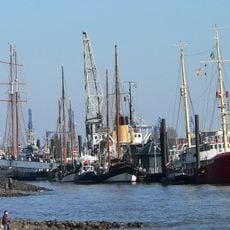
The ship lies at the Neumühlen pier by the Museumshafen Oevelgönne in Hamburg. In summer she leaves her berth for events such as the Hamburger Hafengeburtstag, Kieler Woche, Flensburger Dampf-Rundum and Hanse Sail Rostock, and can also be chartered. Access to the engine room and bridge involves steep stairs and narrow passages.
The ship's Runeberg bow, used for the first time in Germany, cut ice with a sharp cutting frame instead of crushing it under the hull's weight. This bow shape shaped later icebreaker construction. Look for the white "EISBRECHER" lettering on the black midship hull.
The community of curious travelers
AroundUs brings together thousands of curated places, local tips, and hidden gems, enriched daily by 93,500 contributors worldwide.