Kreuzberg, Mountain summit near Bischofsheim an der Rhön, Germany.
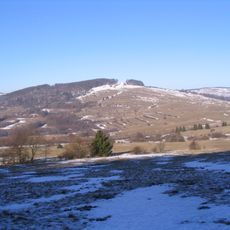
Kreuzberg rises to 927.8 m in the Hohe Rhön, the highest summit lying entirely in Lower Franconia. Its upper slopes are covered by bare deciduous trees with patches of snow, dark conifers lower down; a low building and a banded lattice mast stand on the rounded summit ridge. A treeless strip runs from the northern saddle to the top and serves as a ski slope in winter.
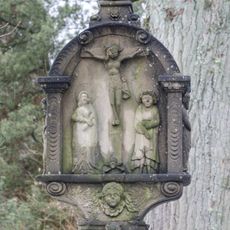
The mountain was called Aschberg until the 17th century, after a sacred ash tree venerated there in pre-Christian times. The name Kreuzberg dates from 1582, when Prince-Bishop Julius Echter of Würzburg had a Crucifixion group erected on the summit. Franciscans founded the monastery below the summit in 1644.
The monastery beer is brewed by laypeople under the monks' supervision, not by the monks themselves, who stopped brewing on site around 1992. Three beers (Dunkel, Pilsner, Hefe-Weizen) are made year-round and a Weihnachts-Bock at Christmas, about 8,500 hectoliters a year. The name Kreuzberg dates only from 1582, when Würzburg's Prince-Bishop Julius Echter had a Crucifixion group set up; before that the mountain was called Aschberg.
The mountain is accessible from the north via hiking routes or ski lifts, with marked trails offering different difficulty levels. Depending on the season and weather, visitors should bring appropriate clothing and footwear.
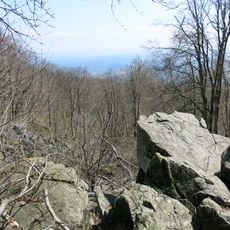
The lattice mast on the summit, banded light and dark, replaced a 156 m guyed mast erected in 1951 and used until 1985; the current mast stands 208 m tall. East of it lies the Basaltblockmeer Johannisfeuer, a field of massive basalt blocks.
The community of curious travelers
AroundUs brings together thousands of curated places, local tips, and hidden gems, enriched daily by 92,853 contributors worldwide.