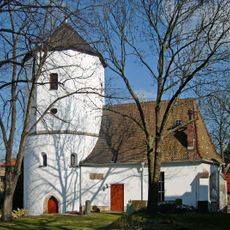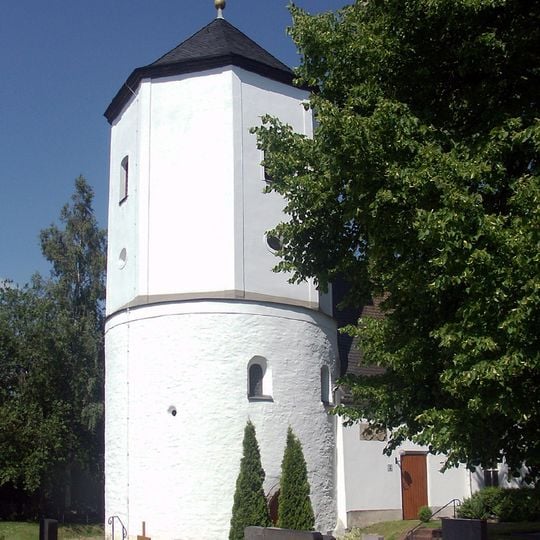
Andreaskirche, Romanesque church in Leipzig-Knautnaundorf, Germany.
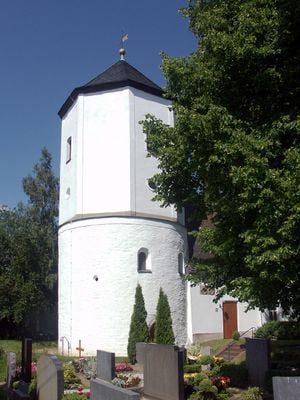
Andreaskirche is a church building with Romanesque features in Leipzig-Knautnaundorf, built from heavy stone with rounded arches and a symmetrical layout. Its simple interior preserves the basic structure that medieval churches needed for their religious function.
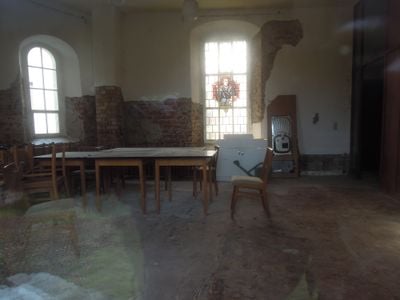
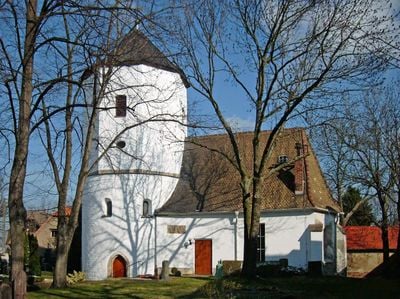
The round tower shaft belongs to a chapel built before 1100, linked by analogy to Wiprecht von Groitzsch's castle chapel at Groitzsch. Around 1500 the apse was demolished and a late Gothic hall with polygonal end was added. In 1719–1723 the octagonal upper tower was rebuilt and galleries installed; after a 1972 lightning strike the Romanesque chapel interior was reconstructed by 1994 under Gerhart Pasch.
The chapel is dedicated to Saint Andrew, and the surrounding cemetery still serves the village. A coat of arms stone for Caesar Pflugk and his mother Agnes Loser, both of whom died in 1578, was moved here from the demolished church at Eythra and is mounted on the building. The three cast-iron bells came in 1954 from the church at Bösdorf, which was destroyed by open-cast lignite mining.
The chapel stands on Rundkapellenweg in Knautnaundorf, about 12 km from Leipzig's centre, surrounded by a small cemetery. The interior is split: the medieval round chapel and the former nave, now a parish hall, are reached through separate entrances. The building has been under monument protection since 1977 and was undergoing extensive renovation in 2025, so access may be limited.
The round tower's lower shaft, nearly ten metres across, is the oldest surviving part, dated to before 1100 by comparison with the chapel remains at Groitzsch castle. Its link to Wiprecht von Groitzsch, whose Bohemian wife came from a region of round churches, suggests a lost manor site here.
The community of curious travelers
AroundUs brings together thousands of curated places, local tips, and hidden gems, enriched daily by 93,940 contributors worldwide.