Teltow Canal, Industrial waterway in southern Berlin, Germany.
The Teltow Canal is a 38.39-kilometre federal waterway running from the Griebnitzsee near Potsdam east to the Dahme between Köpenick and Grünau, partly forming the Berlin-Brandenburg border. It has a single lock, at Kleinmachnow, with a mean fall of 2.86 metres. The channel is at least 37 metres wide, with a minimum bridge clearance of 4.50 metres at mean water and a permitted draught of 2.00 metres.
The canal was planned around 1900 and officially opened in 1906 after construction was completed under Emperor Wilhelm II. It was created to ease trade between different regions and improve Berlin's infrastructure.
The towpath alongside the canal is today a place where people walk, cycle, and spend time by the water. The green spaces around it matter to local residents and visitors as a natural retreat from the city.
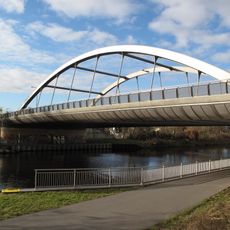
The canal is a federal waterway with a single lock at Kleinmachnow, where boats drop about 2.86 metres. Bridges leave only 4.4 to 4.5 metres of clearance at mean water, and the permitted draught is 2 metres, or 1.75 metres between kilometres 34.1 and 37.84. The water is at least 37 metres wide, and the kilometre markers count from west to east.
When the canal was created, it made use of existing water streams and lakes in the region, which shaped its construction. This practical approach made building more efficient because natural water resources were cleverly integrated into the system.
The community of curious travelers
AroundUs brings together thousands of curated places, local tips, and hidden gems, enriched daily by 93,658 contributors worldwide.