Burg Castle, Medieval castle in Solingen, Germany.
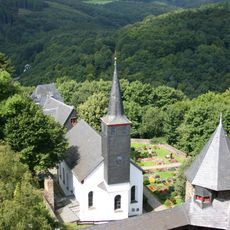
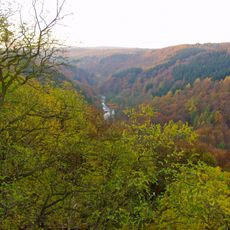
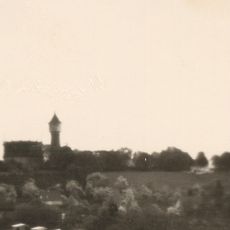
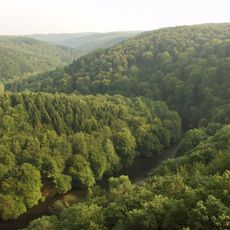
Burg Castle stands above the Wupper valley in Solingen, a reconstructed hilltop complex whose oldest part was built around 1150. Its most prominent element is a tall square tower of grey-brown stone with a steep dark roof, dormer windows and a slender spire. Lower buildings with matching roofs and small pointed turrets extend to the right, their windows small and a few balconies projecting; trees obscure the base.
Count Adolf II of Berg built the castle above the Wupper around 1133, on the site of an older fortification; it was first documented in 1160 as novum castrum. Between 1218 and 1225 Archbishop Engelbert I of Cologne enlarged it with a two-storey hall building and made it his family's main residence. After 1648 imperial troops destroyed the fortifications, and from 1887 the Schlossbauverein rebuilt it under architect Gerhard August Fischer, work lasting from 1890 to 1914.
The interior rooms display weapons, guild chests and household goods that show how people worked and lived in earlier times. Walking through the spaces, you see the tools and objects that filled everyday life in the region, from weaving looms to craftsmen's benches.
A cable car connects the valley with the upper grounds and saves visitors the steep climb on foot. Guided tours last about an hour, and paths in the courtyard and exhibition rooms are mostly level and accessible without steps.
The castle's name is a linguistic contradiction: "Schloss" denotes a representative palace while "Burg" means a fortification, so "Schloss Burg" reads as "palace castle". The site only received this name in the 15th century, after its conversion into a hunting castle; earlier documents call it novus mons or novum castrum, "new mountain".
The community of curious travelers
AroundUs brings together thousands of curated places, local tips, and hidden gems, enriched daily by 93,015 contributors worldwide.