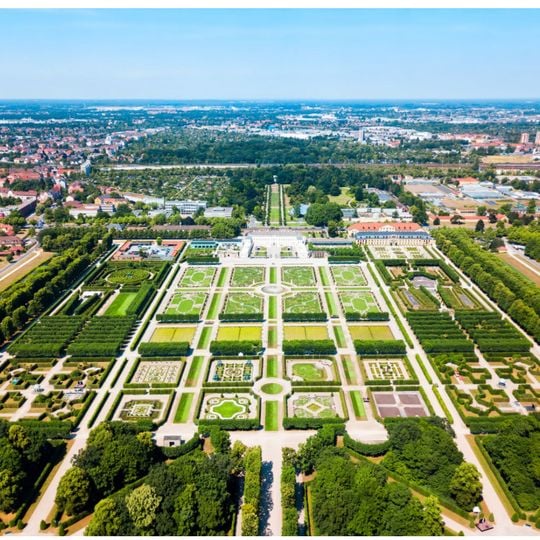
Herrenhausen Gardens, Garden ensemble in Herrenhausen, Hanover, Germany
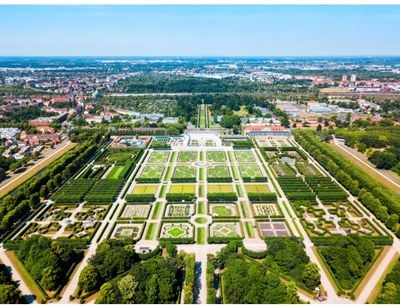
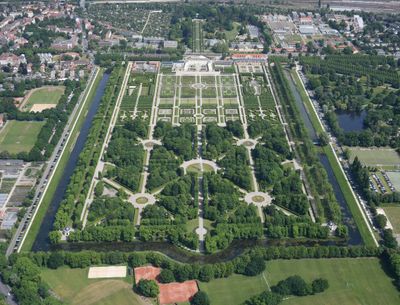
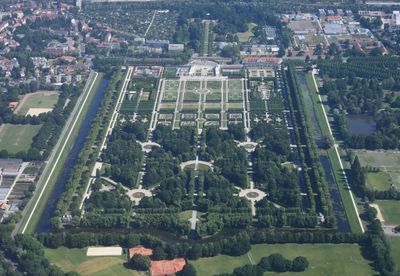
Herrenhausen Gardens comprise four separate gardens in Herrenhausen, a district of Hanover: the Great Garden, Hill Garden, Georgen Garden and Guelf Garden. The Great Garden, about 50 hectares, is laid out in strict geometrical patterns of lawns, hedges and walkways, with narrow canals along its outer edges and the rebuilt Herrenhausen Palace at its northern end.
Duke George of Calenberg laid out a kitchen garden at the village of Höringehusen in 1638; his son Johann Friedrich renamed the village Herrenhausen in 1665 and had a pleasure garden built. From 1679 to 1698, under Electress Sophia, Martin Charbonnier enlarged the garden in the Dutch Baroque manner. The Great Fountain, devised with Gottfried Leibniz, was inaugurated in 1719 before George I and reached about 35 metres by 1721.
The Garden Theatre in the Great Garden is used in summer by the Landesbühne Hannover for musicals and plays. The Orangery, built 1720–1723 by court architect Böhm, hosts art exhibitions and classical concerts, with matinees in its foyer. Each summer the garden also stages the Kleines Fest im Großen Garten during the Herrenhausen festival weeks.
The site divides into four areas: Great Garden, Hill Garden, Georgen Garden, and Guelf Garden, each presenting different plant collections and layouts. A full visit requires several hours if you wish to explore all sections.
The Great Garden's grotto, a store room in the 18th century, was reworked between 2001 and 2003 by Niki de Saint Phalle and her coworkers with mosaics of moulded glass and mirrors, crystals, minerals and seashells. Two rooms branch off an octagonal central room, each with a statue set in a wall recess.
The community of curious travelers
AroundUs brings together thousands of curated places, local tips, and hidden gems, enriched daily by 94,363 contributors worldwide.