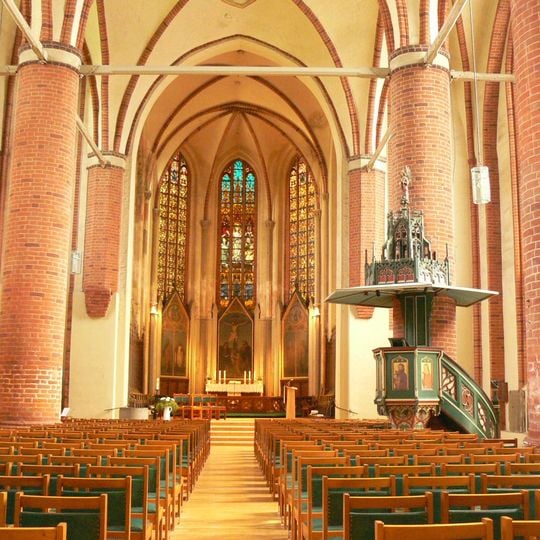
St. Jacobi church, Brick Gothic church in Greifswald, Germany
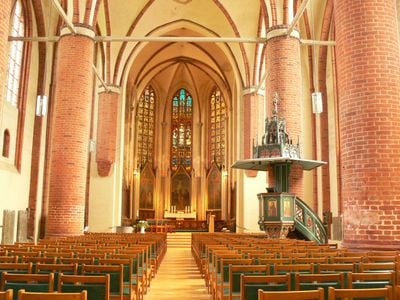
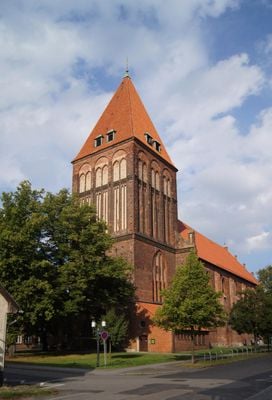
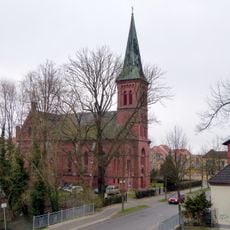
St. Jacobi is a Brick Gothic hall church at the western edge of Greifswald's old town, built of red brick with a square west tower and a polygonal, set-back choir. Eight round pillars on high bases divide the broad central nave from two very narrow aisles, and the interior shows a mix of glazed and unglazed brick. The nave is covered by a ribbed vault on wooden corner shafts with leaf-carved corbels, and a slender metal tie rod spans the space between the pillars.
The church was first mentioned in 1275, when Duke Barnim I of Pomerania transferred its patronage to the St. Spiritus Hospital; its first pastor, Hermann, is recorded for the same year. Construction of the two-nave hall church began around 1280, starting with the two eastern bays and the west tower. A patronage dispute with Eldena Abbey, confirmed by the pope in 1298, and a fire in 1461 marked its medieval history.
The church is dedicated to James the Great and lies on the Via Baltica, a branch of the Way of St James. Because it is the smallest of Greifswald's three medieval parish churches, locals call it the "little James". Four guilds used it in the Middle Ages, among them the Mariengilde and the Brotherhood of the 12 Apostles; gravestones of the Letzenitz family, patrons of the vanished Marienkapelle, remain inside.
The building was thoroughly modernized between 1979 and 1982, with heating installed and new flooring added throughout. These updates make visiting more comfortable during colder months while preserving its historical appearance.
The church was used as a fodder store and later as a field bakery during the Napoleonic occupation of Greifswald. Earlier, in the Great Northern War, it served from 1715 as a powder magazine, and in the Thirty Years' War as a grain and flour store.
The community of curious travelers
AroundUs brings together thousands of curated places, local tips, and hidden gems, enriched daily by 94,442 contributors worldwide.