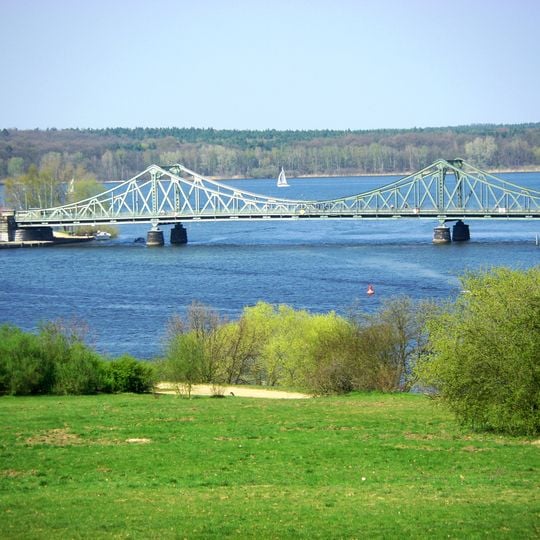
Glienicke Bridge, Steel bridge between Berlin and Potsdam, Germany
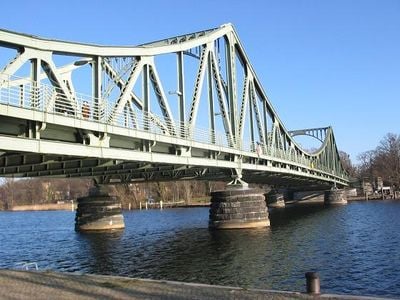
Glienicke Bridge is a steel truss road bridge carrying Bundesstraße 1 across the Havel narrows between the Jungfernsee and the Glienicker Lake, linking Berlin-Wannsee with Potsdam. Its flat central span has crisscrossing truss sides, with shorter sections sloping up toward the centre, and the deck rests on four piers between stone abutments. Four stone centaurs by sculptor Stephan Walter stand on high pedestals at the ends of the two truss girders.
A wooden bridge was built here around 1660; Karl Friedrich Schinkel's brick and wood bascule bridge followed in 1834. The Prussian government's 1904 competition was won by the Johann Caspar Harkort Company of Duisburg, and the present steel truss bridge opened on 16 November 1907. An unexploded shell damaged it in April 1945, and reconstruction finished in 1949.
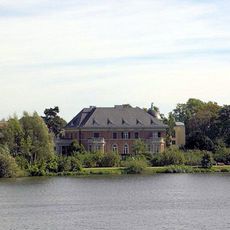
The name comes from nearby Glienicke Palace, which sits within the surrounding park landscape and shapes the character of the area. Today the crossing serves mainly as a link between two federal states and sees regular use by walkers and cyclists who enjoy the river views.
Bundesstraße 1 runs across the span and allows car traffic between both banks. Pedestrians and wheelchair users can also cross, as the full width is accessible throughout.
A white line down the center once marked the boundary between East and West and made this spot a preferred exchange point. Three exchanges took place here between 1962 and 1986, which drew public attention to this crossing.
The community of curious travelers
AroundUs brings together thousands of curated places, local tips, and hidden gems, enriched daily by 92,835 contributors worldwide.