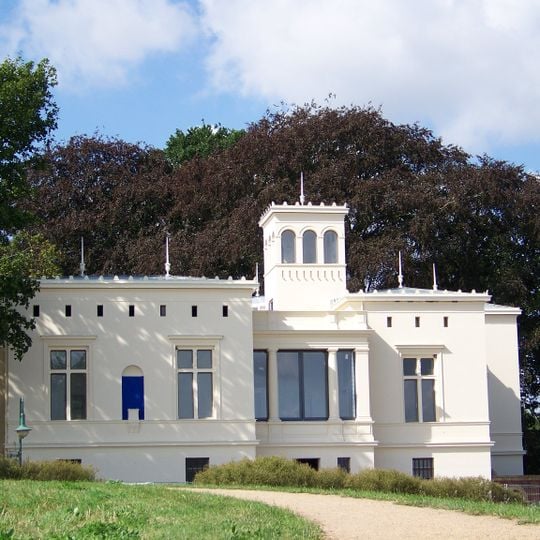
Villa Schöningen, Historic villa in Nördliche Vorstädte, Potsdam, Germany
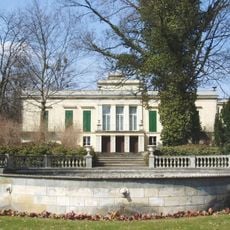
Villa Schöningen is a long, flat-roofed villa at Berliner Straße 86, built in the Italian Villa style with a cream-white rendered facade. It is symmetrical, with low side wings and a taller central section topped by a square tower with a crenellated parapet, three arched windows and a flagpole. Tall multi-paned windows line the ground floor, and a blue arched niche sits on the left.
Ludwig Persius designed the residence in 1843 for chamberlain Kurd von Schöning under instruction from Prussian King Friedrich Wilhelm IV. The property survived Germany's turbulent history and was later transformed into an art venue.
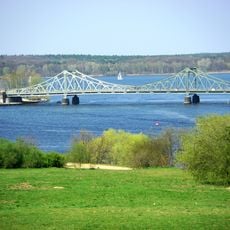
The villa's museum, opened in November 2009 by Angela Merkel with Henry Kissinger and Mikhail Gorbachev present, recounts the Glienicke Bridge, used from 1949 to 1989 for exchanging captured agents between the Soviet bloc and the West. A video installation by Stefan Roloff belongs to the permanent exhibition. The house is named after Schöningen, the East Brunswick town the Schöning family came from.
The villa stands at Berliner Straße 86, at the corner with Schwanenallee, a few metres west of the Glienicke Bridge. The building is a listed monument and lies within the UNESCO-listed Palaces and Parks of Potsdam and Berlin. The museum inside is privately funded and opened in November 2009.
The building stood near Glienicke Bridge during the Cold War, where captured agents were exchanged between Soviet and Western forces. This proximity to a place of secret diplomacy makes the villa a witness to divided history.
The community of curious travelers
AroundUs brings together thousands of curated places, local tips, and hidden gems, enriched daily by 93,750 contributors worldwide.