Hohenneuffen Castle, Medieval castle in Neuffen, Germany
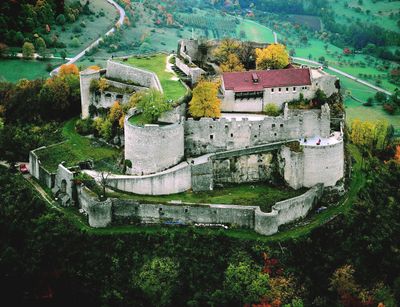
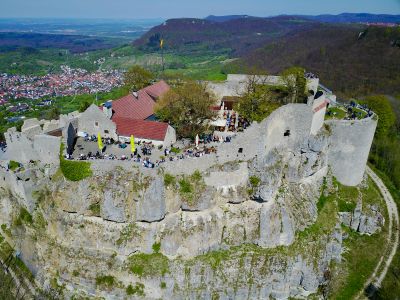
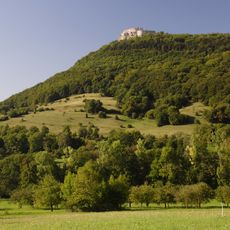
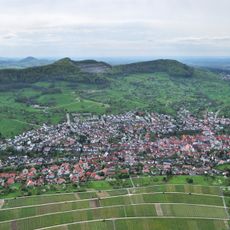
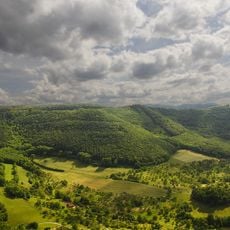
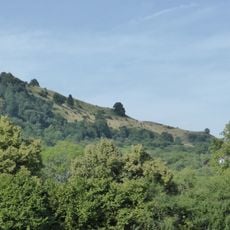
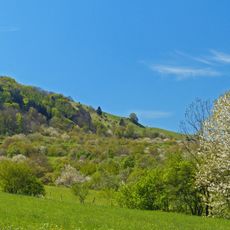
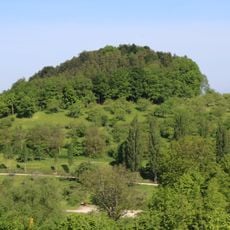
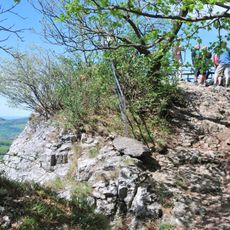
Hohenneuffen is the ruin of a large hilltop fortress on the 745 m Festungsberg, a White Jurassic rock at the edge of the Swabian Alb above Neuffen. Duke Ulrich had barbicans, round towers, bastions, casemates, stables, an armoury and two cisterns built in the mid-16th century; parts of the casemates can be entered today.
The castle was built between 1100 and 1120 by Mangold von Sulmetingen and passed through several noble families over time. In 1301, it came under the control of the Württemberg Counts, securing its political importance to the region.
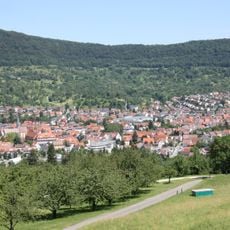
The name Neuffen is disputed: one reading traces it to a Celtic word *Nîpen, interpreted as "battle castle"; another derives it from Germanic *hnîpa, "steep slope". The English source instead links it to proto-Celtic nobos, "holy", suggesting a religious role for the mountain 2,000 years ago. Since the 19th century the donkey has been Neuffen's mascot, from a legend in which besieged defenders threw a grain-filled donkey stomach into the enemy camp.
The site is easily accessible on foot from the town center with well-marked trails leading up the hillside. Wear appropriate footwear since the climb is steep and paths can be uneven in places.
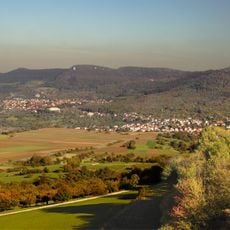
On 2 August 1948 Reinhold Maier, prime minister of Württemberg-Baden, invited the three south-western states to Hohenneuffen to discuss a merger. Leo Wohleb of Baden defended the old state uncompromisingly, and no agreement was reached. The meeting nonetheless began the process that produced Baden-Württemberg in 1952. Maier chose the spot for its view over the occupation-zone border.
The community of curious travelers
AroundUs brings together thousands of curated places, local tips, and hidden gems, enriched daily by 94,357 contributors worldwide.