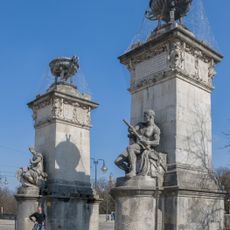
Rhine Water Fountain, Bronze fountain in Lehel, Munich, Germany.
The Vater-Rhein-Brunnen is a neo-baroque bronze fountain by Adolf von Hildebrand, created 1897–1903. Its central figure personifies the river god Rhenus, with putti and water features around the basin. The inscription Argentorato refers to Strasbourg, for which it was made. Since 1932 it has stood on the Museumsinsel north of the Ludwigsbrücke; the original balustrade is missing, so the basin is freely accessible.
Adolf von Hildebrand created the fountain between 1897 and 1903 for Strasbourg, where it stood on the Broglieplatz in front of the Stadttheater; the donor was the Alsatian notary Sigismund Reinhard. It was inaugurated on 6 June 1902, but the bronze Rhine god's posture and laugh drew mockery and comic postcards. Dismantled in 1919 after French troops entered Strasbourg, the bronze was exchanged in 1929 for Ernst Weber's Meiselocker, and the fountain was rebuilt on the Museumsinsel in 1932.
The fountain's name honors the Rhine, one of Germany's most important rivers, and reflects how this waterway was celebrated in local artistic traditions. The bronze figures show how the river was imagined and personified by artists of that time.
The fountain sits in the middle of the Museum Island district surrounded by several major museums within walking distance. Plan to visit this area when you are touring nearby cultural institutions, since everything is located very close together.
The sculpture depicts figures known as Rhine Children, a reference to romantic ideals about the river popular in 19th-century German art. This connection to the Romantic movement reveals how artists of the time imagined and celebrated natural forces through mythological storytelling.
The community of curious travelers
AroundUs brings together thousands of curated places, local tips, and hidden gems, enriched daily by 92,840 contributors worldwide.