Ludwig bridge Munich, Arch bridge on Museum Island, Munich, Germany.
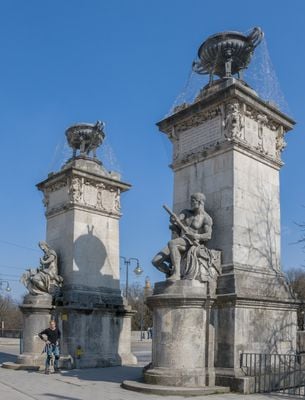
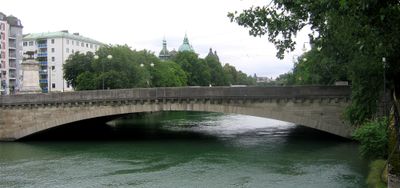
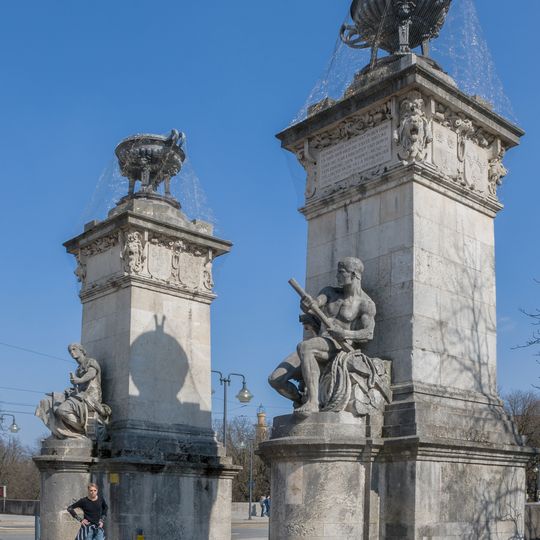
Ludwigsbrücke is a road bridge over the Isar made of two successive arch structures separated by Museum Island: the Inner Ludwigsbrücke crosses the Große Isar, the Outer Ludwigsbrücke the Kleine Isar. Both are reinforced concrete arches clad in natural stone, with a plain grey parapet and a row of rectangular stone corbels under the deck. The piers carry seated stone figures and metal urns.
A bridge at this crossing is first documented in the Regensburg arbitration of 1180, after Henry the Lion diverted the salt trade from Oberföhring; the Augsburg arbitration of 1158 does not yet mention one. Floods repeatedly destroyed the wooden structure. The outer bridge over the Kleine Isar was rebuilt in stone from 1823 to designs by Carl Probst with architectural additions by Leo von Klenze, and was inaugurated on 3 May 1828 as the Ludwigsbrücke, named after King Ludwig I. The present reinforced concrete bridges date from 1934/35.
The bridge is named after King Ludwig I, in whose honour the outer span was inaugurated on 3 May 1828. Its predecessor over the Kleine Isar had collapsed in the flood of 13 September 1813, killing about 100 people. The design came from city building councillor Carl Probst, with architectural additions by Leo von Klenze.
The bridge is open to both pedestrians and vehicles, providing direct access from the city center to the German Museum on Museum Island. Walking across offers good views of the river area and the neighborhoods on both sides.
The bridge was built to replace an earlier structure that collapsed during the severe river flood of 1813 with heavy loss of life. The new supports were constructed with especially durable stone and deep foundations to withstand future overflow from the river.
The community of curious travelers
AroundUs brings together thousands of curated places, local tips, and hidden gems, enriched daily by 92,873 contributors worldwide.