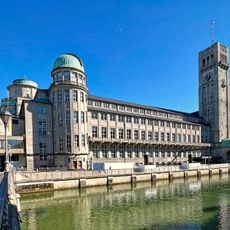
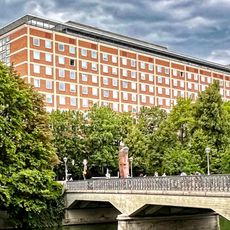
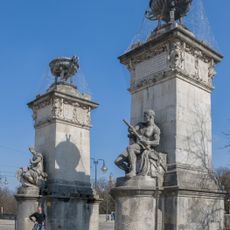
Deutsches Museum library, Museum library at Ludwigsvorstadt-Isarvorstadt, Germany
The Deutsches Museum library is a research library housing one of Germany's largest collections on the history of science and technology. The holdings span from early printed books and manuscripts to contemporary scientific journals, documenting how knowledge has evolved across different fields.
Founded in 1903 on the initiative of Oskar von Miller and Walther von Dyck, the library opened to the public in 1908 in the former National Museum on Maximilianstrasse. It moved to Erhardtstrasse in 1925/26, and its own building by German Bestelmeyer opened on 7 May 1932. The upper floor was destroyed in World War II, but the ground-floor book holdings survived intact; the rooms were returned to the library in 1959.
The library has indexed articles from specialist journals since 1907, not just whole volumes, so individual essays can be found in the catalogue. Much of the annual intake arrives as donations: in 2015 gifts made up over 70 percent of new media, thanks to long ties with donating publishers, firms and private individuals.
The historic reading rooms have 125 seats and are run as a reference library: books are consulted on site and not lent out. Access is free for everyone and the library is open daily except for a few days each year. It sits on Erhardtstraße in the Ludwigsvorstadt-Isarvorstadt district, opposite the museum's collection building.
The library holds a rare collection of original printed works from the early days of scientific publishing, including pioneering mathematics and astronomy texts. These early publications reveal how scholars documented and shared their discoveries before the era of modern scientific journals began.
The community of curious travelers
AroundUs brings together thousands of curated places, local tips, and hidden gems, enriched daily by 93,601 contributors worldwide.