St. Lawrence, Gothic church in Nuremberg, Germany
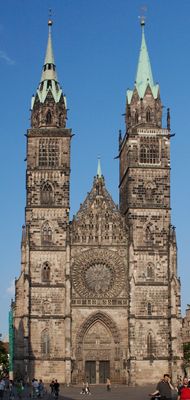
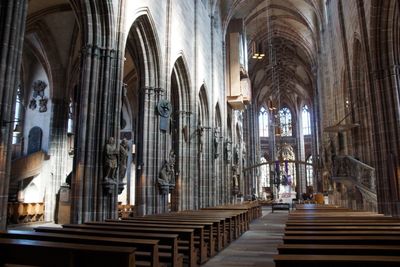
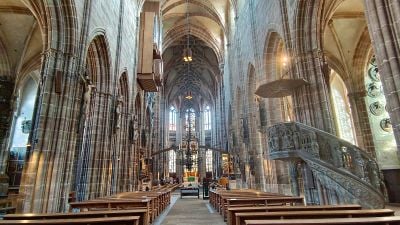
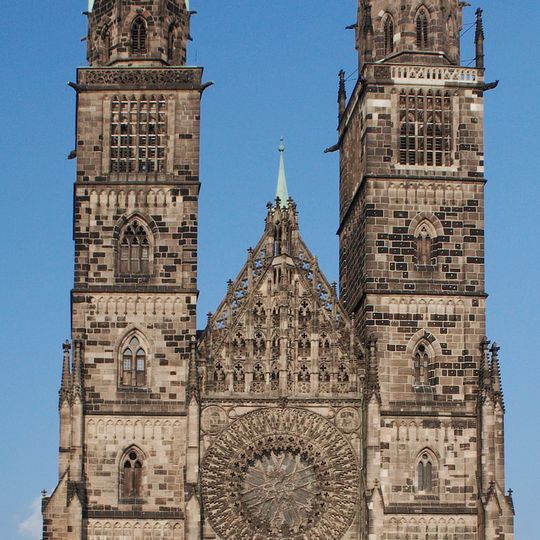
St. Lawrence is a Gothic church built of grey-brown sandstone, with two square towers flanking a steep gable filled with carved niches and topped by a small green spire. Between the towers is a large rose window set within a pointed arch. Inside, clustered piers rise to pointed arches and ribbed vaulting, with dark wooden benches facing the altar beneath tall stained-glass windows.
A chapel dedicated to Saint Lawrence is documented in 1235 and 1258; parts of its early 13th-century Romanesque predecessor were reused in the walls. The three-aisled basilica was begun around 1250 and finished around 1390, and around 1400 the aisles were widened so that the buttresses became private chapels of council families. The hall choir over the Deocarus altar was built from 1439 to 1477 by Konrad Heinzelmann, Konrad Roritzer, Matthäus Roritzer and Jakob Grimm. Air raids in 1943 and 1945 destroyed roof, vaults, floor, seating and organ; rebuilding began in 1949 and the first service was held at Laurentius Day 1952.
The interior displays works by artists who shaped Nuremberg's identity, including carvings and stone sculptures by local masters. These artworks show the connection between the city's craftsmanship and its religious life.
The main entrance is at the west portal beneath the rose window, facing the Lorenz square; the interior is entered from there down the nave toward the raised choir. The floor is level and the aisles allow walking around the pews. The church is an active Lutheran parish, so visits may be limited during services.
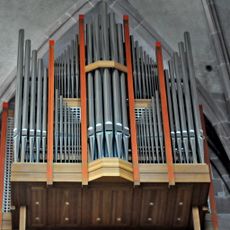
The interior houses multiple organs, including a main instrument that was restored in the early 2000s. The restoration also preserved a historical organ from the 19th century that still plays today.
The community of curious travelers
AroundUs brings together thousands of curated places, local tips, and hidden gems, enriched daily by 93,009 contributors worldwide.