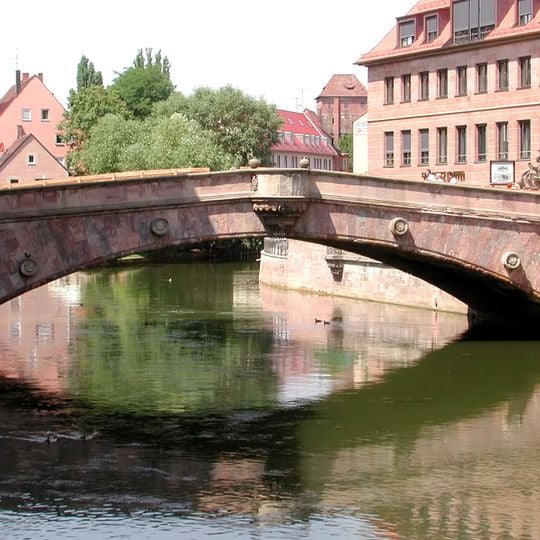
Fleischbrücke, Late Renaissance stone arch bridge in Nuremberg, Germany
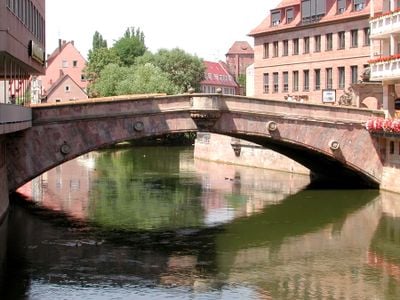
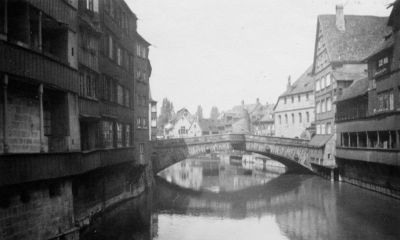
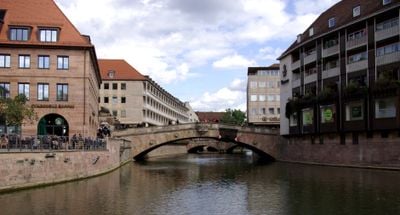
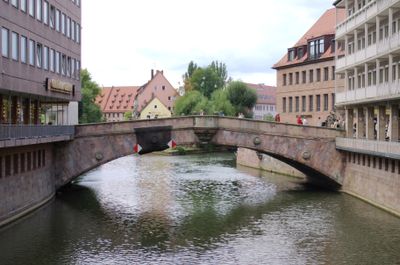
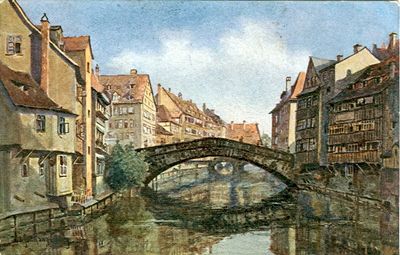
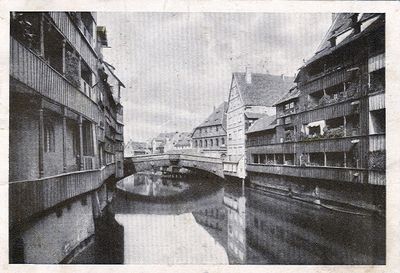
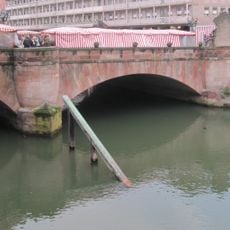
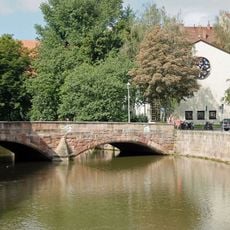
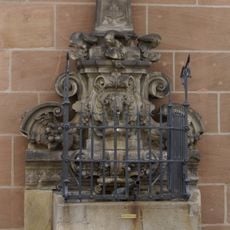
The Fleischbrücke is a single-arch stone bridge over the Pegnitz in Nuremberg, linking St. Sebald and St. Lorenz. Its segmental arch has a clear span of 27 m and a rise of 4.2 m; the structure is 61 m long and 15.3 m wide. The reddish Burgsandstein masonry carries a low parapet with stone posts, circular medallions above the arch, and a carved bracket below the deck.
Construction took place between 1596 and 1598, replacing an older structure that suffered repeated flood damage along the river. The new stone design aimed to be more durable and better withstand the pressures of flowing water.
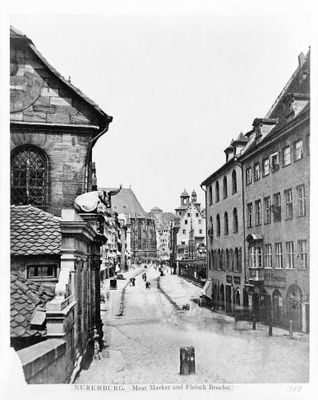
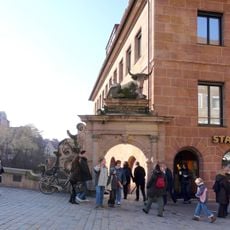
The bridge is named after the Fleischhaus, a meat house that stood nearby. Its best-known stone figure is the ox above the Ochsenportal on the north bank, added in February 1599. A Latin inscription there reads that the ox was never a calf, a joke visitors can still read at the portal.
The bridge lies just south of the Hauptmarkt, linking St. Sebald and St. Lorenz on the old town's main axis. Its flat, broad deck is paved and open to pedestrians, with low stone parapets on both sides. The Latin inscription and the stone ox sit at the northern portal, while the honorary plaque of the Historic Landmark of Engineering is at the southern end toward Kaiserstraße.
At its completion, this featured the largest masonry arch in the German-speaking lands and demonstrated innovative engineering techniques. The ratio of span to rise of about 6.4 to 1 pushed construction methods of the time to their limits.
The community of curious travelers
AroundUs brings together thousands of curated places, local tips, and hidden gems, enriched daily by 94,485 contributors worldwide.