Gänsemännchenbrunnen, Water well in Nuremberg, Germany.
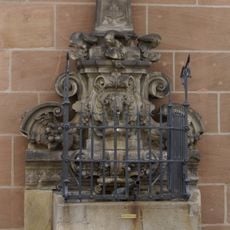
The Gänsemännchenbrunnen is a Renaissance fountain whose bronze figure shows a farmer, not a boy, carrying two geese under his arm. Cast by Pankraz Labenwolf around 1550 after a wooden model by Hans Peisser, it stands on a stocky shaft above a renewed cup-shaped sandstone basin, within a wrought-iron grille set with rosettes. Water leaves through the two geese's beaks and two pipes at the figure's base.
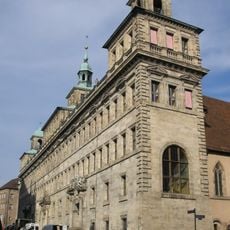
Cast in bronze around 1550 by Pankraz Labenwolf from a wood model by Hans Peisser, the fountain figure stood on the Gänsemarkt, today's Obstmarkt. After the Second World War it was moved to the courtyard of the new town hall at Hauptmarkt 18. About 20 replicas are known, including one at Hohenschwangau and one in Weimar.
The bronze figure is a farmer in the dress of the Knoblauchsland, the vegetable-growing area north of Nuremberg, carrying two geese under his arm. One proposal identifies him as Philipp Melanchthon, who in 1526 opened Nuremberg's first public school; the geese then stand for his pupils. Jakob Wassermann named a novel after the fountain.
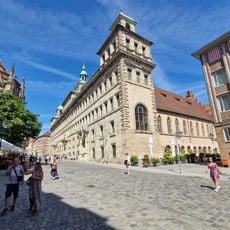
The fountain stands in the courtyard of the Rathaus-Neubau behind the Hauptmarkt, at Hauptmarkt 18, not on the open square. Enter from the Hauptmarkt side and look for the sandstone basin with its iron grille. The bronze figure is small, so step close to see the two spouts at the geese's beaks.
Around twenty replicas of the figure are known, some bearing the stamp of the Lenz art foundry. A reduced cast stands in Weimar opposite Schiller's house, another copy is at Hohenschwangau Castle, and one is on Hirschenplatz in Lucerne. Goethe ordered a terracotta copy of the figure for himself.
The community of curious travelers
AroundUs brings together thousands of curated places, local tips, and hidden gems, enriched daily by 92,640 contributors worldwide.