St. Sebaldus, Gothic church in Nuremberg, Germany
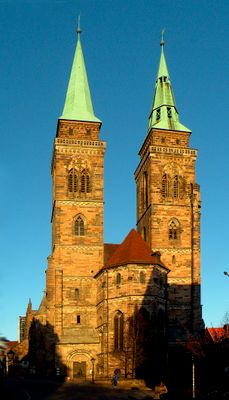
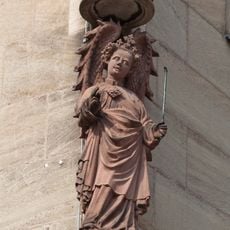
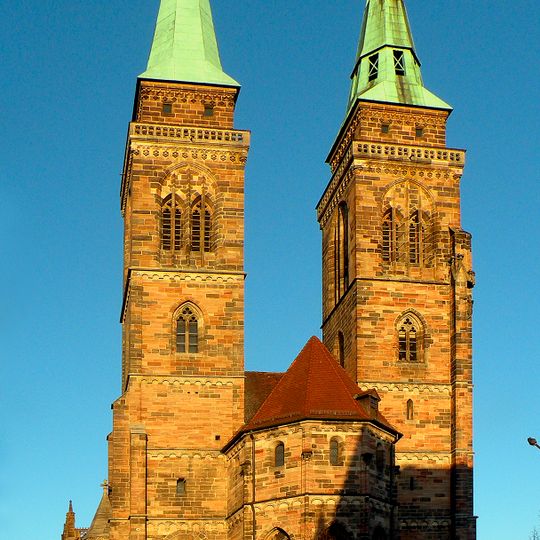
St. Sebaldus is a Gothic church built of reddish-brown stone, with two square towers capped by green copper spires and a lower central section under a steep red-tiled roof. Bands of carved stone run across the towers, and the south aisle holds the Last Judgment portal with its tympanum of the Last Judgment.
Built from 1225/1230 to 1273 as a double-choir pillar basilica modelled on Bamberg Cathedral, it became Nuremberg's council church. The side aisles were widened from 1309, and in the Parler period (1361–1372) the east choir over Sebaldus's grave became a hall ambulatory choir. Bombing in 1940–1945 destroyed roof and vaults; after rebuilding it was reconsecrated on 22 September 1957.
The church was Nuremberg's council church from the 14th century, and until the late 15th century almost only the city's patrician families were allowed to donate fixed furnishings here. The hall choir windows were donated by the mayors of 1379. The name comes from Sebaldus, an 8th-century hermit and missionary buried in the church as the city's patron saint.
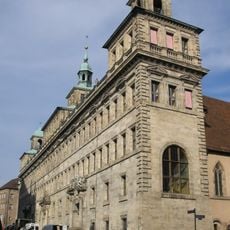
The church is located at Albrecht-Dürer-Platz near the old city hall and is accessible during regular opening hours. Guided tours are offered regularly throughout the week and provide deeper insight into the art and architectural features.
The main organ was built in 1440–41 by Heinrich Traxdorf, who also made two small organs for the Frauenkirche. Rebuilt in 1691, its modified case was destroyed in the bombing raid of 2 January 1945. The present instrument, with 4 manuals and 84 stops, was installed in 1975. Organists here included Johann Pachelbel (1695–1706) and his son Wilhelm Hieronymus (1719–1764).
The community of curious travelers
AroundUs brings together thousands of curated places, local tips, and hidden gems, enriched daily by 92,952 contributors worldwide.