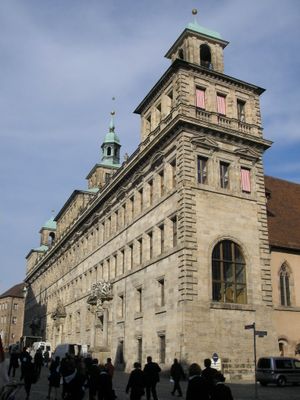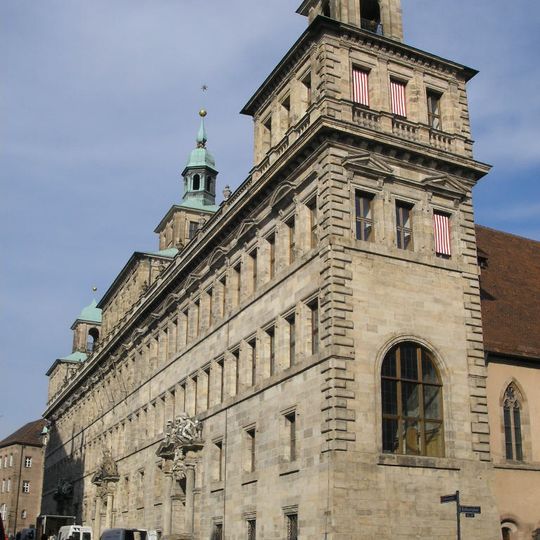
Altes Rathaus Nürnberg, Renaissance town hall in Nuremberg, Germany.
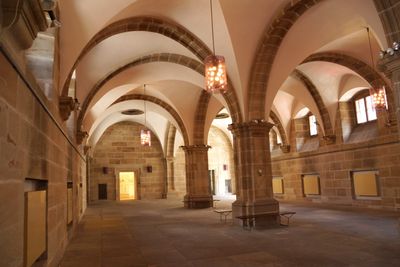
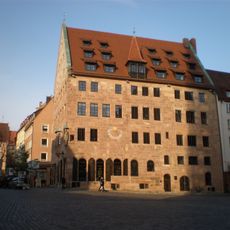
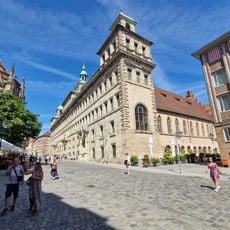
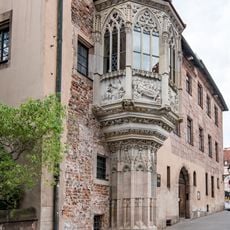
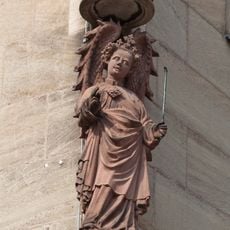
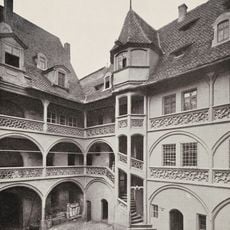
The Altes Rathaus Nürnberg is a Renaissance four-wing complex begun in 1616 by Jakob Wolff the Younger, with a uniform window front and three Baroque portals whose sculptures, including figures from the Book of Daniel, were carved by Leonhard Kern from 1617. Above the central portal is the coat of arms of the Holy Roman Empire. The south side incorporates a 14th-century Gothic hall building.
Nuremberg had no town hall until the 14th century; the council met in the clothiers' Gewandhaus. In 1322 the council bought an estate from Heilsbronn Monastery, and in 1332–1340 city architect Philipp Groß built the Gothic hall on the south side. Jakob Wolff the Younger's Renaissance four-wing building followed in 1616–1622, halted by the Thirty Years' War and finished after it.
The Great Hall served many purposes for the city's people, from hosting court sessions and dances to gathering spaces for citizens. This variety shows how central the building was to Nuremberg's daily life.
Visitors should be prepared for stairs and different levels, as the interior has multiple floors and not all areas are easily accessible. Guided tours provide insights into how city administration worked.
The Great Hall's mural cycle, begun in 1521 and finished in 1528/30, was the largest wall and ceiling painting in Europe at the time, surpassed only by the Sistine Chapel begun ten years later. The 1944 photo documentation was lost, so the walls stayed white after 1988; a 2012 video installation projected the recovered 1944 images onto them.
The community of curious travelers
AroundUs brings together thousands of curated places, local tips, and hidden gems, enriched daily by 93,092 contributors worldwide.