Frauenkirche, Gothic church in Market Square, Nuremberg, Germany.
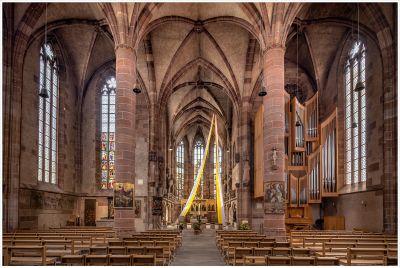
The Frauenkirche is a brick Gothic hall church on the east side of Nuremberg's Hauptmarkt, built 1352–1362 with three by three bays. Its west front carries a projecting porch with a balcony, flanked by two engaged stair towers, and a stepped gable by Adam Kraft (1506–1508) holding the Männleinlaufen clock. Behind rises a narrow octagonal tower with a copper dome; the other facades are plain.
Charles IV ordered the church built between 1352 and 1362 on the site of Nuremberg's synagogue, destroyed in the 1349 pogrom. Peter Parler is often named as architect, though this is unproven. Wenceslas was baptized here in 1361, when the Imperial Regalia were shown. Lutheran from 1525, it was bought by a Catholic parish in 1810 and restored by 1816 under Lorenz Rotermundt; bombing left only nave walls and facade, repaired by 1953.
The name Frauenkirche means Church of Our Lady. Since 1948 the balcony beneath the Männleinlaufen has opened the Christkindlesmarkt, and at noon the clock's seven electors circle Emperor Charles IV three times, a custom tied to the Golden Bull of 1356.
The church stands on the east side of the Hauptmarkt, its west porch facing the market square. The interior is open to visitors; the balcony below the Männleinlaufen is not a public viewing platform and is used for the opening of the Christkindlesmarkt. The west facade was renovated in 2003 and the interior in 2023.
The Männleinlaufen, a clockwork installed in the west gable in 1509, was funded by Charles IV to recall the Golden Bull, whose first 23 chapters were drafted in Nuremberg and proclaimed at the 1356 court diet. At noon, seven electors circle the emperor three times. A clock at the church is documented as early as 1361.
The community of curious travelers
AroundUs brings together thousands of curated places, local tips, and hidden gems, enriched daily by 92,860 contributors worldwide.