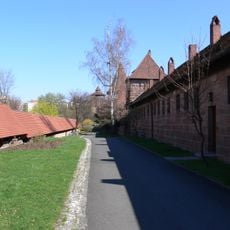
Wasserturm, Medieval water tower in Nuremberg, Germany
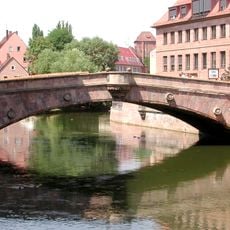
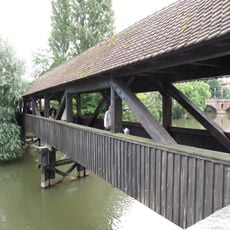
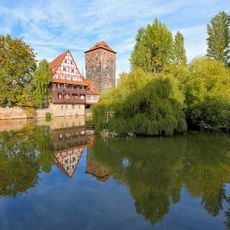
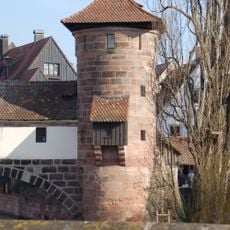
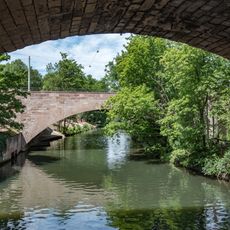
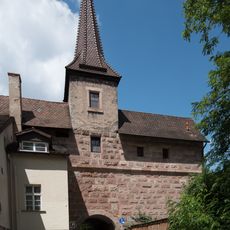
The Wasserturm is a square wall tower on the north bank of the Pegnitz in Nuremberg, built into the city's penultimate fortification ring and joined to the neighbouring Weinstadel. Its lower storeys are of rusticated ashlar, its upper two of brick, with loopholes, windows and a hipped roof. A two-arched sandstone bridge with half-timbering and a gabled roof links it to the smaller Henkerturm on the Trödelmarkt island.
The square tower was built between 1320 and 1325, with the lower storeys of bossed ashlar and the upper two of brick. It guarded the outflow of the Pegnitz; once the last city wall was raised from 1400, it lost that role and served as a prison. A 1940 replanning of the Pegnitz north bank foresaw its demolition, which did not happen.
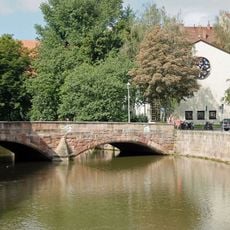
The name Wasserturm refers to the tower's position directly above the Pegnitz, not to any stored water. It is joined to the neighbouring Weinstadel, and a two-arched sandstone bridge with half-timbering and a pitched roof links it to the smaller Henkerturm on the Trödelmarkt island. Since the 20th century the tower and Weinstadel have served as a student residence.
The tower sits near the Pegnitz River and is accessible by public transportation throughout Nuremberg. Visitors can view it from outside and examine the medieval construction details from various angles.
The tower's name comes from its position directly over the Pegnitz, not from storing water. A 1940 redevelopment plan for the north bank called for its demolition, but it was never carried out. Today it serves, together with the adjoining Weinstadel, as a student residence.
The community of curious travelers
AroundUs brings together thousands of curated places, local tips, and hidden gems, enriched daily by 94,072 contributors worldwide.