Weinstadel, Medieval heritage building in Nuremberg, Germany
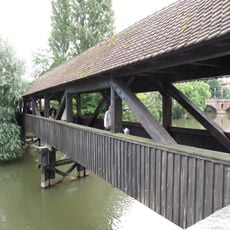
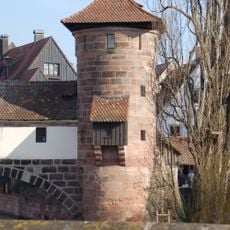
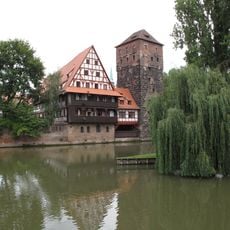
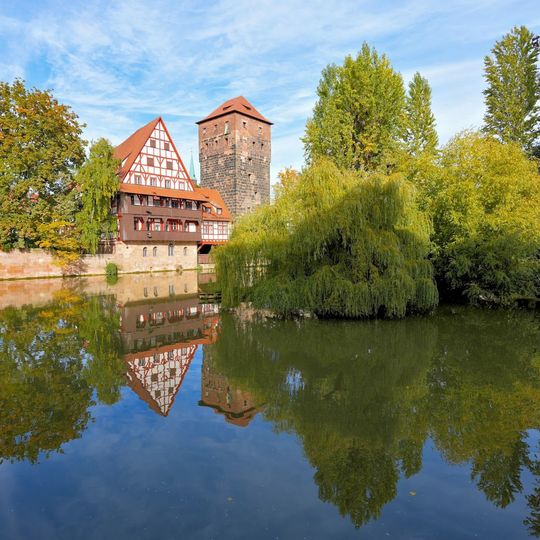
The Weinstadel is a 48-metre-long half-timbered building on the Pegnitz at Maxplatz, the largest of its kind in Germany. Above a sandstone ground floor rise two timber-framed storeys and a three-level saddle roof. Its east side has Nuremberg's oldest dormer, dated 1448, and a bridge-like timber link to the Wasserturm, a former city-wall tower.
Built between 1446 and 1448 outside Nuremberg's second-to-last city wall, the Weinstadel sheltered and fed lepers for three days during Holy Week, funded by a special alms established in 1394. From around 1571 its ground floor served as the imperial city's wine store, giving the building its name. After the leper feeding moved to St. Johannis in 1575, artisans, poor families, a women's spinning house and a sickroom used it; the sickroom moved to the Schauhaus in 1627. Bomb hits on 3 October 1944 caused severe damage.
The name Weinstadel comes from the imperial city wine store set up around 1571 on the ground floor. Since 1950 the building, joined to the Wasserturm, has served as a student dormitory of the Nuremberg student union with 74 places. The east gable dormer of 1448, with its pointed-arch window, is considered Nuremberg's oldest roof dormer.
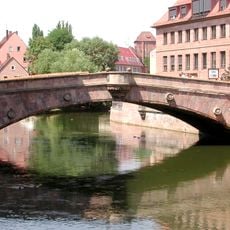
The building now houses student dormitories and remains visible from outside, though not open to visitors inside. The best view comes from the adjacent Henkersteg bridge, which runs right alongside it.
The building is 48 metres long, making it the largest half-timbered house in Germany. Its east side carries Nuremberg's oldest roof dormer, dated 1448, with a pointed-arch window. A bridge-like timber section joins it to the old city-wall Wasserturm, which in turn stands over a covered bridge to the Trödelmarktinsel.
The community of curious travelers
AroundUs brings together thousands of curated places, local tips, and hidden gems, enriched daily by 93,788 contributors worldwide.