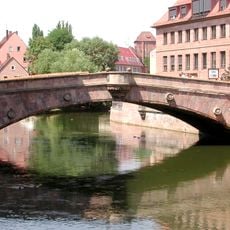
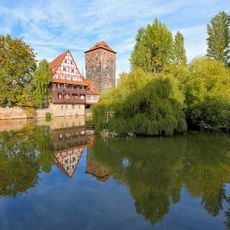
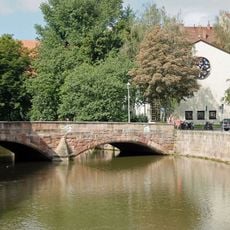
Maxbrücke, Stone arch bridge in Nuremberg, Germany.
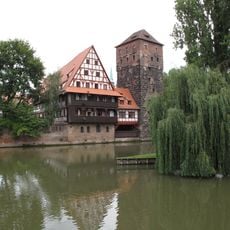
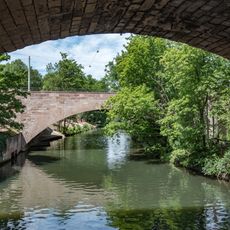
Maxbrücke is a stone arch bridge crossing the Pegnitz River in Nuremberg, linking the central area with the district east of the water. Multiple arches made of stone support both foot traffic and vehicles traveling between these areas.
Jakob Grimm, a master builder from Rothenburg, completed the bridge in 1457, when it was called Steinerne Brücke. Two gun rondels were later added to defend the city against attacks from the river. In 1810 it was renamed Maxbrücke in honour of King Maximilian I Joseph of Bavaria. After a fire destroyed the wooden water tower of the Nägeleinsmühle, Bernhard Solger repaired and redesigned the bridge, which reopened in 1852.
The bridge's name honours King Maximilian I Joseph of Bavaria, who gave it its current name in 1810; the nearby Maxplatz was renamed for the same reason. Its earlier name, Steinerne Brücke (Stone Bridge), is still recalled in local usage. The crossing links the Unschlittplatz in the Lorenzer Altstadt with the Nägeleinsplatz in the Sebalder Altstadt.
The bridge is easily walkable year-round for pedestrians and cyclists with good views of the river and surrounding city. Parking is available nearby, and you can comfortably cross from either riverbank on foot or by bike.
The bridge's cast-iron tracery infill is a later addition: after a fire in the wooden water tower of the Nägeleinsmühle on the north bank damaged the span, it was repaired and redesigned to plans by Bernhard Solger and reopened to traffic in 1852. Two gun rondels had earlier been built onto it to defend the city against attacks from the river.
The community of curious travelers
AroundUs brings together thousands of curated places, local tips, and hidden gems, enriched daily by 92,803 contributors worldwide.