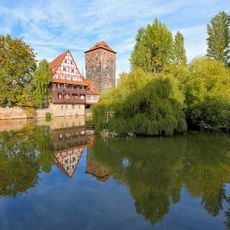
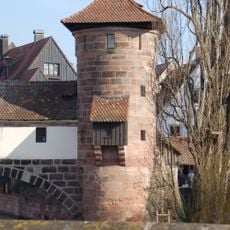
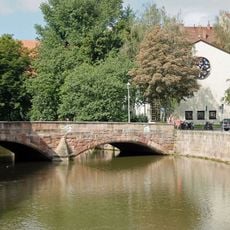
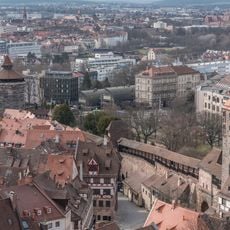
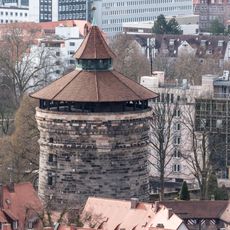
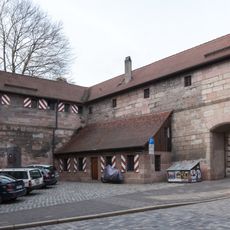
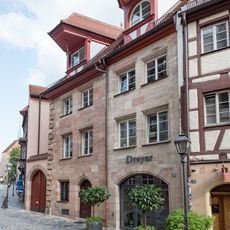
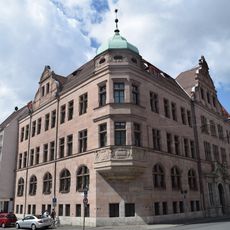
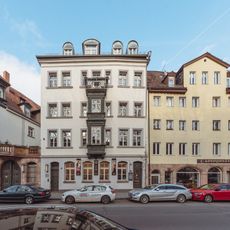
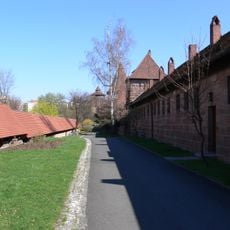
Hallertor, Pedestrian gate in the Nuremberg city wall, Nuremberg, Germany
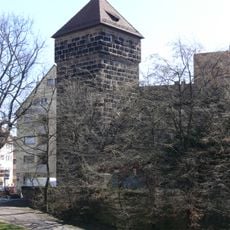
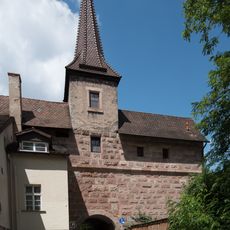
The Hallertor is a medieval city gate with stone walls and arched passages that was part of Nuremberg's historical fortification system. The structure displays typical defensive architectural features with thick walls and narrow passages.
The Hallertürlein was built as a small pedestrian gate during the construction of Nuremberg's last city wall, completed around 1400, matching the Wöhrder Türlein on the east side. Its present form dates from a rebuilding in 1519. It is named after the Hallerwiese, which belonged to the Haller von Hallerstein patrician family until 1434.
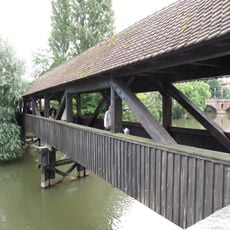
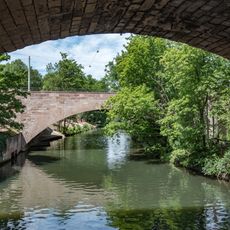
The gate's name comes from the Hallerwiese meadow, which belonged to the patrician Haller von Hallerstein family until 1434. Its old nickname was "Grünes G" (Green G). Albrecht Dürer painted "Trockensteg beim Hallertürlein" here, showing the gate and its footbridge.
The gate is located centrally in the old town and is easily accessible on foot from Nuremberg's center. The nearest tram and bus stops are within easy walking distance.
Albrecht Dürer painted his picture "Trockensteg beim Hallertürlein" (Dry Bridge at the Hallertürlein) at this spot, a detail most visitors walk past without knowing. The gate itself was a thin, pointed tower nicknamed "Grünes G" before its 1519 rebuilding gave it the present form.
The community of curious travelers
AroundUs brings together thousands of curated places, local tips, and hidden gems, enriched daily by 92,770 contributors worldwide.